
Do Travel Advisors Need a Website? Probably, Yes.
Blog Overview: This post is for the advisor who's been putting off the website decision, or who isn't sure the investment is worth it when referrals and social media are already working. We'll cover what a website actually does that Instagram can't, what your potential clients are doing before they ever talk to you, and the different ways to get started without losing your mind. [Approx read time: 9 minutes]
You're booking trips, earning referrals, showing up on Instagram, maybe running a Facebook group that actually has decent engagement. Business is happening. So the website keeps getting bumped to the bottom of the to-do list, somewhere between 'figure out a CRM' and 'finally organize that Google Drive situation.'
I get it. When something is working, spending money and energy on a website feels like a someday project. And if we're being honest, part of the hesitation probably isn't even about the money. It's the whole thing. The tech, the copy, the 'what do I even put on there,' the creeping feeling that you'll start it and abandon it halfway through.
So let's actually talk about this. Not the 'every business needs a website!' version you've heard a hundred times, but the real reasons it matters specifically for travel advisors, and what it changes when it's done well.
The short answer is yes, you need one. But the why is what makes it worth reading, so stick around.
First: What Are Your Potential Clients Actually Doing Before They Call You?
This is the part you don't get to see, and it's the part that matters most.
Someone gets your name from a friend. Great. They're interested. So what happens next? They Google you. Every single time. And whatever they find (or don't find) in that moment is shaping whether they reach out or move on to someone whose online presence made the decision easier.
They might not be able to articulate exactly what they're looking for, but it usually comes down to a few things:
What do you specialize in? Not just 'travel advisor.' They want to know if you're the right fit for their kind of trip (see my post on positioning)
Are you legit? Testimonials, a professional-looking presence, anything that confirms the referral was a good call (grab my free feedback framework!)
How do you work? Nobody wants to be surprised on a discovery call. They want a sense of your process before they commit their time (grab the Welcome Guide)
What does it cost? Even a general idea. They want to know they're in the right ballpark before reaching out.
Does this feel like someone I'd trust with my trip and my money? This is the gut-check one. Less about specifics, more about overall impression.
If those answers aren't easy to find, you're relying entirely on the strength of the referral to carry someone through to a conversation. Sometimes it does. But a lot of the time? People just move on, and you never hear from them. You never even know they were looking.
An Instagram profile with a Linktree is not answering those questions. I know that's not what you want to hear, but it's true.
What a Website Does That Social Media Can't
Nobody is saying stop using social media. It's great for visibility, community, and staying top of mind. But treating it as a substitute for a website is where things start to stall.
Social media is rented space. Your reach depends on an algorithm that changes whenever it feels like it, your content has a shelf life of about 48 hours on a good day, and there's only so much you can communicate in a caption before people scroll past. (We've all done it.)
A website is yours. And it does things social media genuinely can't:
It's permanent. No algorithm changes, no platform outages, no waking up to find your reach got cut in half because Instagram decided to push reels this week.
It's the first thing people find when they Google you. That alone matters more than almost any other marketing thing you could invest in.
It gives you space to actually explain what you do. Your niche, your process, your fees, your personality — all in one place, organized so it actually makes sense. Not scattered across a bunch of posts and highlight reels.
It works when you're not working. Your website is out there doing its job while you're on a client call, researching resorts, or binging Netflix when you’ve tuned out for the day. It doesn't need you to show up every day to function.
You control the story. On social, your content is competing with everything else in someone's feed. On your site, it's just you.
It pre-qualifies your leads. When your site clearly communicates who you work with, how you work, and what it costs, the people who reach out are already aligned. That changes the quality of your inquiries immediately.
Your social media should be pointing somewhere. And if that somewhere is a Linktree or a Facebook page, you're doing a lot of work to drive people to what is essentially a dead end.
The Invisible Work Your Site Does for You
This is where the real return on investment lives, and it's the piece most advisors don't fully appreciate until they experience the difference.
Without a website, every new inquiry starts from scratch. You're explaining what you specialize in, walking through your process, making the case for your fees, answering the same five questions you've answered a hundred times. On every call. With every new person.
That gets old — and exhausting.
A well-built website handles most of that before the call even happens. It explains your niche so the right people find you and the wrong ones filter themselves out. It walks through your process so nobody's surprised. It builds trust through testimonials and a professional presentation. And it sets expectations around fees so you're not spending the first twenty minutes of every discovery call defending your planning fee. (If you've ever felt like you spend more time justifying your value than actually delivering it, this is the fix.)
When your site does that work, your calls are different. You're talking about their trip instead of justifying your existence. The client shows up informed, already trusting you, already past the 'should I even work with an advisor?' question. That's a completely different conversation.
Your Online Presence Should Match What You're Charging
More advisors are charging fees, niching down, and positioning themselves as specialists. That's a good thing. But if your online presence doesn't match that positioning, there's a disconnect that potential clients can feel, even if they can't quite name it.
When someone is about to pay a planning fee upfront, they want to feel like they're making a smart investment. Your website is usually the first place they form that opinion. A polished, well-organized site says 'this person has their act together' before you've exchanged a single word. And that credibility does real work when it comes to converting inquiries into bookings.
It's also worth thinking about what happens when there's nothing there. When someone Googles you and finds an outdated page, a bare-bones social profile, or nothing at all, they're drawing their own conclusions. Those conclusions aren't always generous. In a referral-driven business, your website is either reinforcing the trust someone else built for you, or it's working against it.
If you're charging like a professional, your online presence should look like one too. That's not a judgment — it's just how clients think.
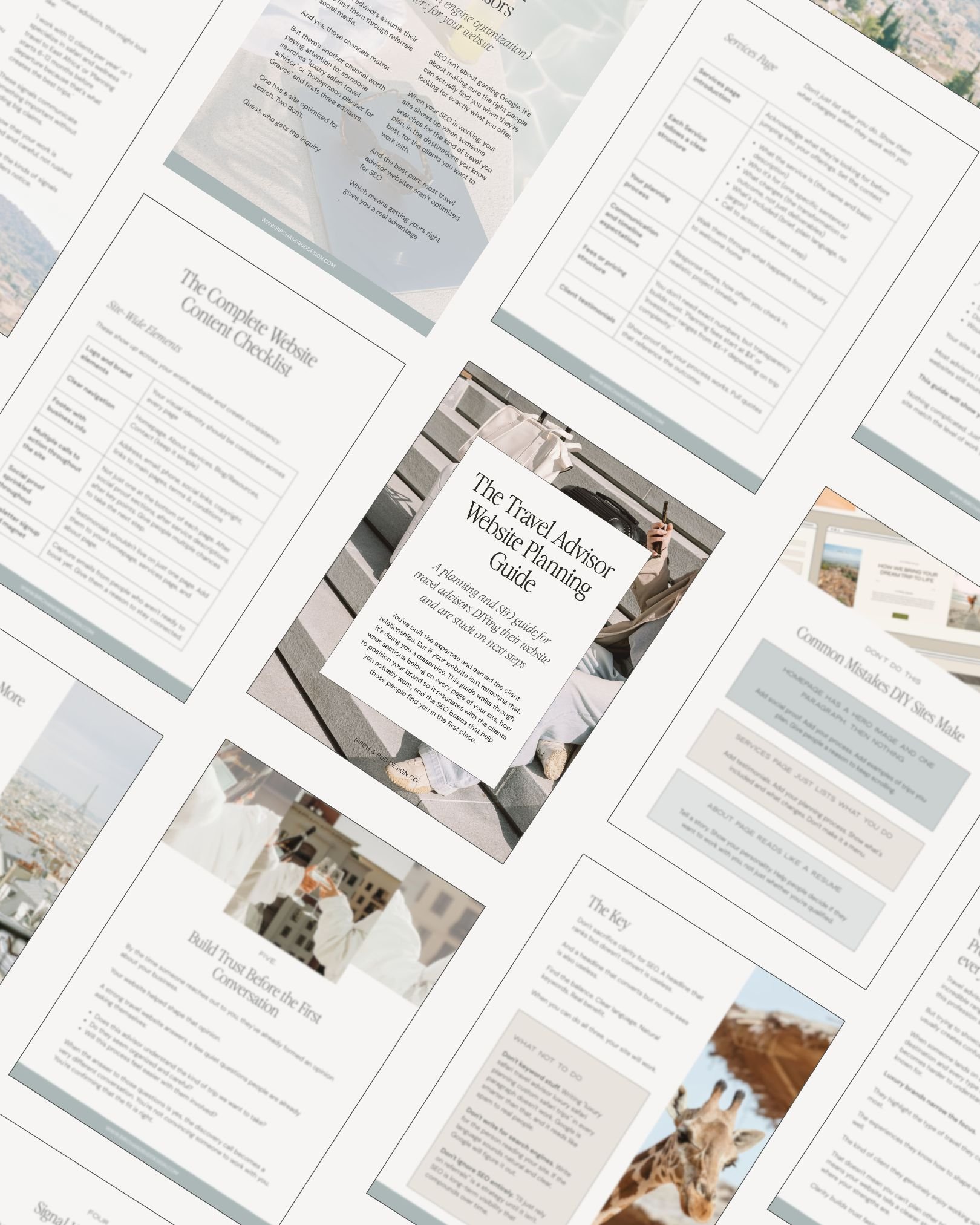
The Website Planning Guide is the missing piece if you’re staring at your new website template, eager to design, then realize you have no idea what you’re supposed to fill the pages with.
This guide starts with the strategy most travel advisor websites skip: how to position your brand so it actually resonates with the clients you want to attract.
Not Ready for a Website? Start With How You Show Up After That First Call
If a website isn't in the budget or the plan right now, there's still something you can do right now to change how clients experience your business.
One of the fastest ways to change how potential clients perceive you is to have a well-designed Welcome and Service Guide that you send after an inquiry or a first conversation. It covers the same ground a website would — who you are, what you specialize in, how your process works, what your packages look like, what clients can expect, and what the next step is — just in a format you send directly.
I created the Travel Advisor Welcome & Service Guide Template for exactly this. It's a 14-page editable Canva template with ready-to-use copy in key sections (your planning process, expectations and fine print, FAQs, and a call-to-action page), plus structured layouts for your services, packages, testimonials, and pricing. You customize it with your own branding and voice, and you've got a cohesive, professional document you can share with every new lead.
It replaces the scattered follow-up emails, the 'did I remember to mention my fee structure?' moments, and the hoping-they-remember-everything-from-the-call energy. For advisors who do have a website, it works as a companion piece that reinforces everything your site already communicates. For those who don't have one yet, it's a genuinely useful place to start.
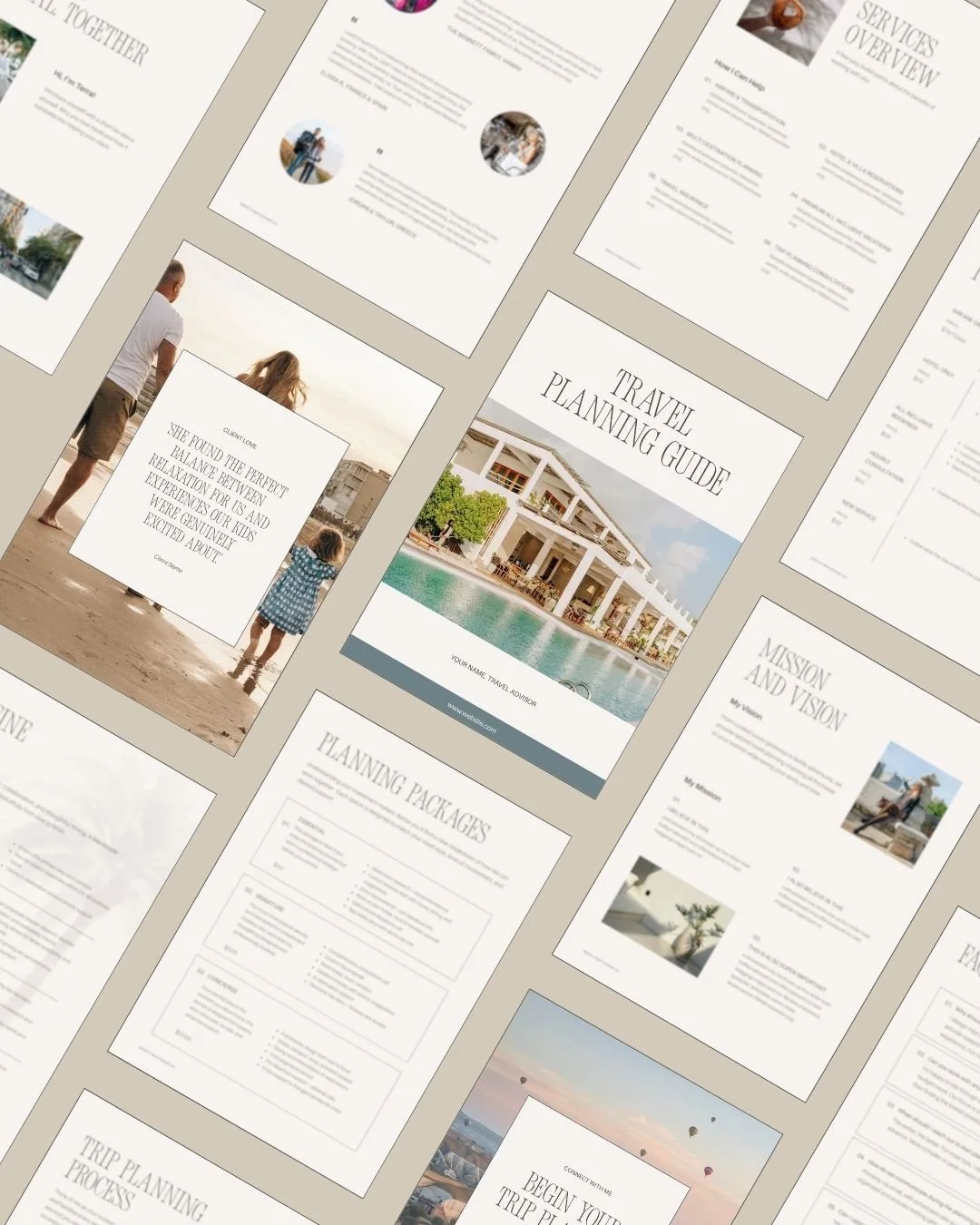
Welcome &Service Guide
A professionally designed, editable Canva template created specifically for travel advisors who want their client experience to feel as elevated as the trips they design.
Start every client relationship with clarity and confidence.
But…What If I'm Not Tech-Savvy?
This one stops more advisors than almost any other objection, and it's usually not really about the tech.
It's about the feeling of staring at a platform you don't fully understand, trying to make decisions about layout and copy and fonts when that's absolutely not in your wheelhouse, and worrying you'll end up with something that looks like you built it at midnight after one YouTube tutorial. (No shade, it’s where Birch & Bud started!)
That's a valid concern. But it's also the most solvable part of this whole equation. The technology can be hired out for — whether you work with a designer or start with a well-built template. The harder stuff — understanding what your clients need to see before they trust you, knowing how to communicate your value, figuring out what makes you different from every other advisor they could work with — you already know all of that. You use it every day. You just haven't applied it to a website yet.
Don't let the tech part be the reason this stays on the someday list. It's the smallest piece of the puzzle.
There's More Than One Way to Get Started With a Website
One of the things that keeps advisors stuck is the assumption that 'getting a website' means committing to a massive, expensive, months-long project. It doesn't have to work that way. Knowing your options makes it much easier to choose the path that fits where you are right now.
A semi-custom template is a strong starting point if you want a professional site without starting from a blank page. You're working within a proven layout that's already designed for structure, flow, and conversion, and customizing it with your own content, images, and branding. This is a practical and somewhat easier option if you want to move quickly, stay within a tighter budget, and still end up with something that looks and feels polished. It's not a DIY-and-pray situation — it's a shortcut that skips the guesswork.
A custom multi-page design (typically four to five pages — home, about, services, contact, and sometimes a blog or resources page) is the move when you want something built specifically around your business, your client's decision-making process, and the way you actually work. Every page is mapped out strategically, from the messaging and layout to the flow that moves someone from curious visitor to qualified inquiry. This is the option for when you're ready to invest in something that reflects the full scope of what you've built.
Both paths lead to a professional, functional website. The difference is in the level of customization and strategic depth. Neither one requires you to be technical. And both are designed to get you out of the 'I'll figure it out eventually' loop and into something that's actually working for your business.

Signs You're Ready and Signs You're Overdue
If you're still on the fence about timing, be honest with yourself about these:
You're probably ready if you've started charging planning fees and you want your online presence to match the professionalism of the service you're actually delivering. Fees signal you take your work seriously. Your website should be backing that up before a client ever reaches out.
You might be overdue if your referrals are consistent, but your conversions feel low. People are hearing about you, but not always following through. Something is getting lost between the recommendation and the research. A website closes that gap.
You're definitely overdue if you've niched down, rebranded, or shifted your focus, and your online presence hasn't caught up. Outdated messaging (or nothing at all) means potential clients are forming opinions based on information that doesn't reflect who you are anymore. That's costing you clients you don't even know about.
If you're just tired of starting every conversation from zero? If you're repeating the same pitch, answering the same questions, and spending the first chunk of every call justifying your value, your website should be handling at least half of that before the call even starts.
Where to Go From Here
If this has you thinking it's probably time to do something about this, you don't need to have it all figured out before you take a step.
If you want to start strengthening your client experience right now, the Welcome & Service Guide Template is a great first move that makes an immediate difference in how you show up after that first inquiry.
And if you're ready to talk through what a website would actually look like for your business — what it would need, which approach makes sense, what the process looks like — I'm happy to have a no-pressure chat about what would make the biggest difference for where you are right now.
Want to take the next step and match your website to your expertise and level of clients you serve? At Birch & Bud Design Co., I understand the heart and soul you put into your work. Your website should be a reflection of that passion, a space where your clients can see the care and thoughtfulness you bring to your role.
If you’re ready to invest in a website that truly represents your brand, I’m here to help!
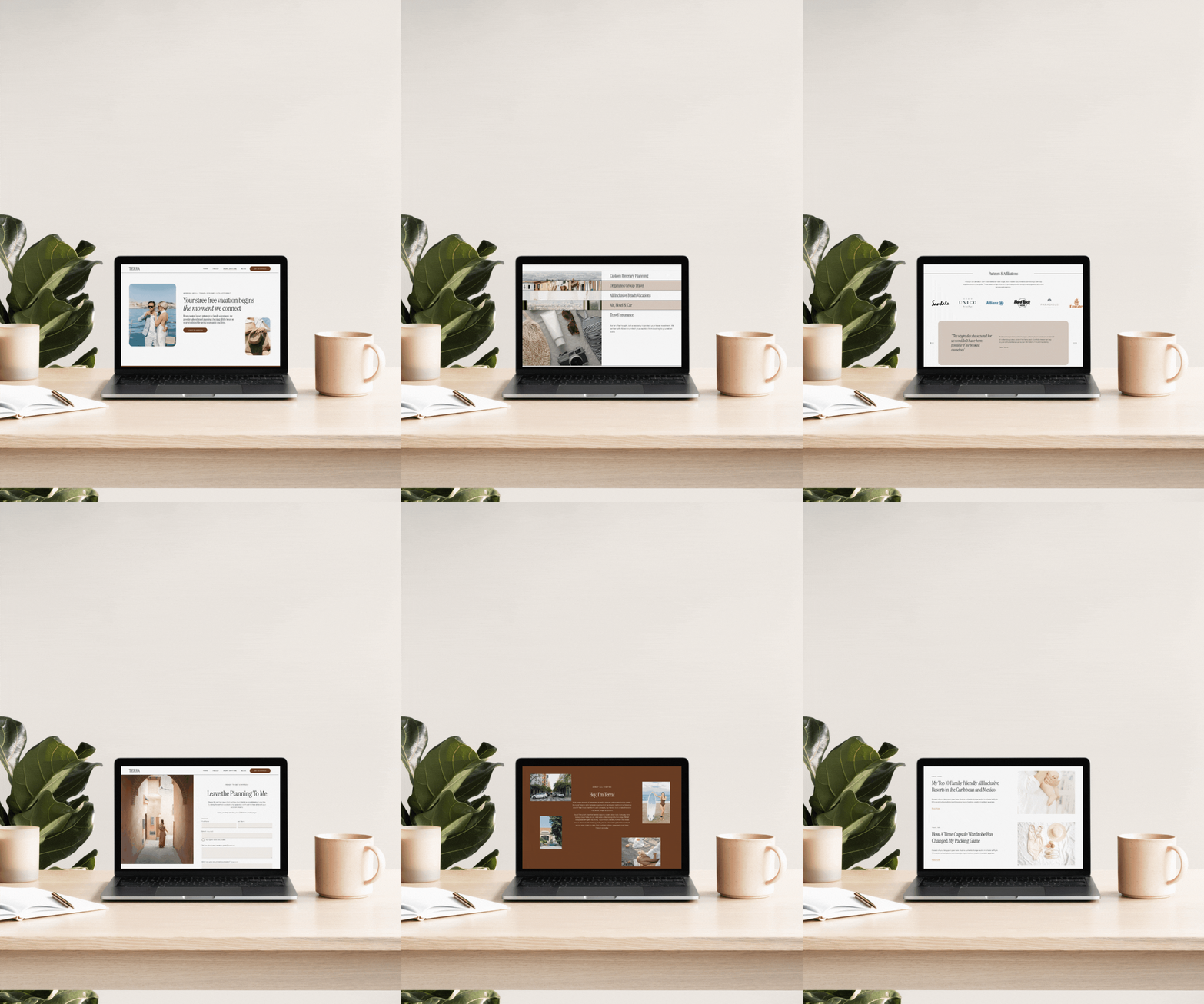

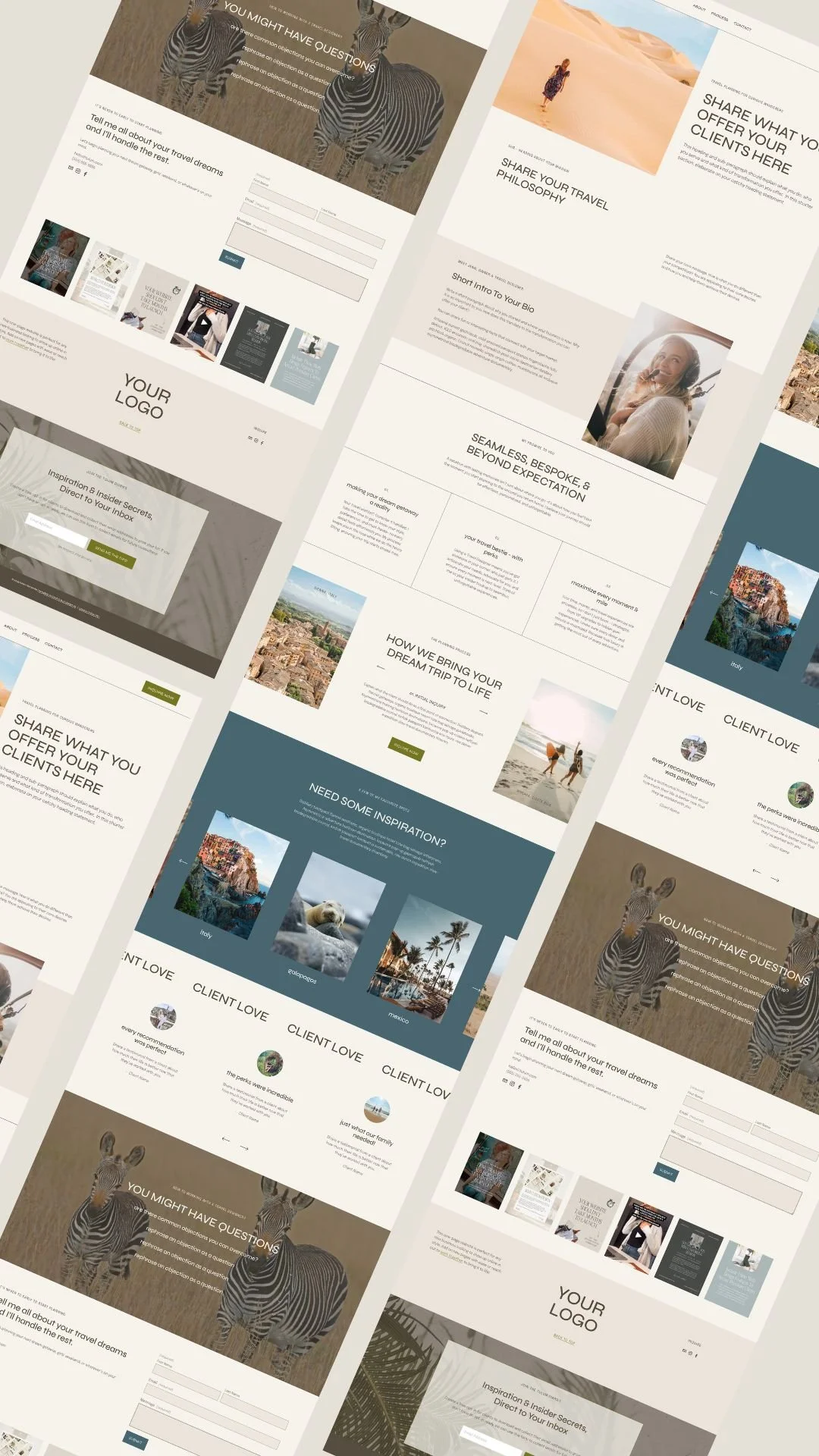




What's actually behind that 'this looks expensive' feeling, and what's working against your positioning without you realizing it. Written for independent Travel Advisors in the FIT, luxury and premium market who are past the 'do I need a website' question