
How Travel Advisors Get Found on Google (Without Competing With Expedia)
Post updated may 20, 2026
Blog Overview: If you've ever Googled yourself and landed on page three, or tried to make sense of SEO advice that felt like it was written for someone else's business, it was. Almost everything written about travel SEO is written for large OTAs like Expedia. This post is specifically for independent Travel Advisors and Agencies. What SEO actually looks like for your type of business, which tactics move the needle, and where to get started. [Estimated read time: 12 minutes]
Note: some links may be affiliate links, and I may make a small percentage of the sale for recommending them. I only recommend businesses I believe in.
Table of Contents
What is SEO
Types of Web Searches
Types of Content You Need on Your Website
What Your Clients Are Actually Typing
Where to Find Your Keywords
Why Google Is On Your Side Right Now, and AI search
Three Things You Can Do Now
The Page(s) You Likely Don't Have
Why Your Blog Posts Should Work Together, Not Independently
A Short Word on Backlinks
What Not to Do
What to Actually Expect
Where to Start This Week & Free Checklist
FAQ
Have you ever searched for yourself the way a client would?
Not your name. That doesn't count.
Something like:
'Italy honeymoon travel advisor'
'luxury safari travel agent in Toronto'
'virgin voyages cruise specialist in Calgary'
And either you didn't show up… or you were buried somewhere no one's clicking.
That's not a visibility problem. It's a strategy mismatch.
Most SEO advice in the travel industry is written for companies you're not trying to be. Booking platforms. Tour operators. Massive content sites competing for 'cheap flights to Cancun.' Trying to follow that strategy as an independent Travel Advisor will have you spinning your wheels for months and getting nowhere. The game you should be playing is smaller, more specific, and a whole lot easier to win.
But, first, what is SEO?
SEO stands for Search Engine Optimization. SEO is how Google decides who shows up when someone searches for something. That's it.
Think of Google like a giant library. When someone types 'luxury safari travel advisor Toronto' into the search bar, Google sends out a little robot to find the best, most relevant answer. SEO is how you make sure your website is the one it finds.
For Travel Advisors specifically, it means using the words your ideal client is actually searching, having pages that clearly match those searches, and proving you know what you're talking about. If your website doesn't do those three things, Google has no reason to show it. No amount of good design fixes that.
The short version: good SEO = the right people finding you on Google/ Search without you paying for ads. And it's a long game.
The Real Problem: You're Writing for the Wrong Searches
This is where many Travel Advisors get discouraged. Most advisors are creating content for browsing intent, not buying intent.
Browsing intent looks like:
'Top destinations for 2026'
'Best beaches in Europe'
'Travel trends this year'
These might pull traffic. They don't bring clients.
Buying intent looks like:
'Italy honeymoon travel advisor'
'luxury safari planner in Canada'
'river cruise specialist for Europe'
These are the searches that turn into inquiries. If your website isn't built around those terms, you're attracting the wrong kind of attention, or none at all.
You Don’t Need to Be Competing With Expedia and Big OTAs
The keywords that those platforms compete for, like 'flights to Rome,' 'hotels in Paris,' 'best resorts Maldives,' are locked up by companies with massive domain authority, entire SEO teams, and years of content behind them. You will not outrank them for those terms, and you don't have to.
What is available (looks a lot like buying intent)
'luxury safari travel advisor in Toronto'
'travel agent for neurodivergent travel'
'adventure travel advisor for solo women'
Smaller search volume. Way higher intent. Way less competition. And the person searching is already looking for someone like you.
The Pages That Lead to Aligned Client Inquiries
Not all pages do the same job. This is where most websites don’t work as well as they should, not from lack of content, but from the wrong types of pages.
1. Specialty service pages (conversion intent)
These are your money pages. Someone searching for 'luxury safari travel advisor Toronto' is close to booking. They need a page that speaks directly to that: your experience with that travel type, what working with you looks like, and why having a specialist matters.
Examples: /luxury-safari-travel-advisor, /italy-honeymoon-specialist, /river-cruise-planner
These are not blog posts with long descriptive titles. They're service pages with clean URLs built to rank for the terms your ideal client types when they're ready to hire. If you currently have one generic 'Services' page covering everything you do, this is the highest-value thing you can build next — assuming you specialize. If you don’t, then curating strategic blog content is your next best bet.
2. Comparison and decision posts (mid-intent)
People getting closer, but still deciding:
'Italy honeymoon vs anniversary trip: what actually changes'
'Serengeti vs Masai Mara: what tips the scale on a first safari'
'Guided vs independent travel in Japan.'
These build trust and position you as the obvious choice before anyone's spoken to you. These are great for blog posts, and people are often typing in questions in full sentence format.
3. Logistics and planning content (early → mid intent)
These pull people in earlier:
'Best time to visit Tanzania'
'Best beach resorts for families with autistic children’
'What to pack for Patagonia'
On their own, they don't convert. Linked back to your specialty service pages? That's where they earn their keep. Again, blog posts.
The Keywords Your Clients Are Probably Typing
The best keywords aren't clever. They're obvious.
The highest-converting searches usually combine:
a destination or travel style
a type of traveller
sometimes a location
Like:
'luxury safari travel advisor in Toronto'
'Italy honeymoon planner'
'family cruise specialist in Canada'
'travel agent for solo female adventure travel'
These are long-tail keywords. Lower search volume, yes. But the person typing them isn't browsing. They're ready.
What Good SEO Looks Like on a Real Page
Weak services page:
'I create custom travel experiences around the world.'
Sounds nice. Does nothing for search.
Strong services page:
'Luxury Safari Travel Advisor for East & Southern Africa'
Specific and searchable. Google knows what it means. So do your clients.
Weak blog title vs Strong Blog Title
'Planning a Trip to Italy' vs 'Italy Honeymoon Itinerary: 10 Days from Rome to the Amalfi Coast'
Google knows exactly what the second one is about. So does the person searching for it. The same principle applies to every page title, heading, and meta description on your website. Specific beats vague, every time.
Where to Find Your Keywords
Googling your own specialty and seeing what comes up is genuinely not a bad start. But here are the tools that give you actual data:
Google Search Console(free) — if your website is live and you're not connected to GSC, stop here and go do that first. It shows you what terms people are already using to find you, what position you're ranking in, and — most usefully — which pages are almost cracking the first page but haven't quite. That 'almost' list is gold.
Google Keyword Planner(free) — built for paid ads, but gives solid volume and competition estimates. Good for validating keyword ideas before you invest time writing around them.
Ahrefs(free tools available) — their free keyword explorer gives basic volume and difficulty data without a subscription. Useful for sanity-checking before you commit to a topic.
Semrush (limited free, paid plans)— more comprehensive; good for seeing what competitor advisors rank for. Probably more than most advisors need to start, but worth knowing it exists.
SEOSpace (free & paid plans) — a Chrome extension built specifically for Squarespace websites. It runs site-wide SEO audits, surfaces keyword opportunities, and gives you a prioritized task list you can action directly inside your Squarespace editor. There's a free plan and paid tiers, with a 7-day trial for paid. If you're on Squarespace and don't want to bounce between five different tools, this is the one I'd start with.
Answer the Public (free & paid plans) — type in a keyword and it shows you every question, comparison, and variation people are searching around that topic. Good for finding blog post ideas that your ideal clients are actually asking Google. The free version limits your daily searches, but it's more than enough to get started.
Honestly? Most of your best keywords come from how your clients already describe what they want. Pay attention to that.
Check out SEOSpace — the Squarespace SEO tool you need to have
Why Google Is On Your Side Right Now
In 2024, Google updated how it evaluates content quality. It now heavily weights E-E-A-T: Experience, Expertise, Authoritativeness, and Trustworthiness.
That first E is the newer addition, and it rewards content written by someone who has actually done the thing.
This is the update that tanked a lot of review aggregator sites. Good news for you.
An OTA can write: 'Tanzania is a great safari destination.'
You can write: 'If you're choosing between the Serengeti and the Masai Mara for your first safari, here's what actually changes the experience.'
That level of specificity and lived experience is now a ranking advantage. Use it.
There's also a distinction Google now makes between commodity and non-commodity content, and it matters for how you write.
Commodity content is what anyone could produce: '7 Tips for First-Time Safari Goers,' a round-up of the 'best beaches in Europe,' a destination overview that reads as if it came from a brochure. It adds nothing that couldn't come from anywhere.
Non-commodity content is the opposite. 'Why We Booked the Masai Mara Over the Serengeti, and What Made the Trip' is non-commodity. So is a specific itinerary with real logistics, or a post that names what to watch out for rather than cheerfully listing highlights.
Google is explicitly rewarding content that goes beyond what a generative AI model could easily produce, which means your first-hand knowledge, your specific client experiences, and your opinion on how to travel somewhere well are now ranking signals.
Write like someone who's been there or experienced it, because you have.
The overarching goal?
focus on deep knowledge of a destination or travel style
share itineraries or resources that assist with real client needs
use an authentic voice that reads as trustworthy and knowledgeable
FAQs to answer specific questions potential clients are searching for
On AI search: What’s Actually Happening & What it Means for You
Let's talk about how AI search actually works, because a lot of what's circulating online is either vague or wrong.
AI Overviews and AI Mode are both Google features, but they're not the same thing.
AI Overviews are the summaries that appear at the top of standard search results, the ones you've probably noticed showing up more often over the past year. They pull a summary of all the ranking articles on the web.
AI Mode is a separate, fully conversational search experience where someone can ask follow-up questions and get an extended AI-generated response. Both can surface your content. They're different surfaces, but the same underlying principle applies to both.
Here's the part that matters: Google's AI features run on something called Retrieval-Augmented Generation, or RAG. When someone asks Google a question, the AI doesn't just generate an answer from its own training data. It searches Google's index first, pulls relevant pages from actual websites, and grounds its response in that content.
What this means in practice: if your website isn't indexed and ranking in regular search, AI Overviews can't cite it. They're drawing from the same pool. This is why your SEO foundation directly determines your AI visibility. They're not separate, and you don't need a different strategy.
Google's AI also uses a process called query fan-out, where a single search triggers multiple related sub-queries behind the scenes. If someone types 'best river cruise advisor for Europe,' Google is also generating queries like 'what to look for in a river cruise specialist,' 'difference between river and ocean cruises,' and 'Europe river cruise itineraries.' This is part of why content clusters work so well, which we'll get to shortly.
Two Things You're Trying to Achieve in AI Search
The goals are different, and they need different approaches.
Informational queries:
'best time to visit Tanzania,' '7-day Kenya safari itinerary' — the goal is to be cited as a source. Your blog posts and FAQ sections do this work.
Recommendation queries:
'best small group safari operator for an immersive experience,' 'who near me specializes in luxury honeymoons in Italy' — the goal is to be named as an option worth considering. This depends less on your website and more on what others say about you: reviews, PR mentions, and authoritative lists.
Your website handles the first. The wider web handles the second. Both matter, and the rest of this post covers both.
A quick note on AI agents
Worth knowing about, even if it's not urgent yet: AI agents, autonomous tools that can browse websites and complete tasks on behalf of users, are starting to be used for research. A prospective client might eventually have an AI agent compare advisor specialties or evaluate a few options before anyone gets contacted. Google has published guidance on making websites accessible to these agents, and it maps directly to what's already good for SEO: clear structure, accessible HTML, clean navigation. Nothing to rebuild for right now but worth keeping in mind as the technology develops.
Three Things You Can Do Now to Improve SEO
Not a 47-step checklist.
1. Your Core Pages Need the Right Words on Them
Check your homepage (Site Title) and services page right now. If your page title says 'Home' or just your business name, that's your first fix.
Does your page title contain a keyword someone might actually search? Not just 'Services.' Something like 'Luxury Safari Travel Advisor (or Agent) | [Your Name].'
Does your meta description (page description) describe who you help and what you specialize in, specifically?
Does your URL slug contain a keyword, or is it whatever Squarespace generated automatically?
That last one catches a lot of DIYers. Squarespace can generate slugs from your full page title, leaving you with '/luxury-travel-advisor-specialising-in-africa-and-italy-for-discerning-travellers,' or it defaults to '/page-1'.
A clean slug like '/disney-travel-designer' takes thirty seconds to fix.
PS. If you are changing ANY URLs that have been active for a while, you need to set up 301 redirects & re-index your website with Google Search Console.
Future Reading on setting up your website SEO:
→ For everything on titles and meta descriptions, check out How to Write Clickworthy Title Tags and Meta Descriptions in Squarespace
While you're in there, check your image alt text. Travel websites are image-heavy by nature, and most of those images have either no alt text or something like 'IMG1575.jpg.' Alt text is both an SEO signal and an accessibility requirement — two reasons to get it right.
→ Full guide on writing SEO & screen reader-friendly Alt Text: How to Write Alt Text for Accessibility in Squarespace
2. Set Up a Google Business Profile
Free, consistently underused by Travel Advisors and solopreneurs. A complete, optimized Google Business Profile puts you in the local map results when someone searches 'travel advisor [your city],' and those results sit above organic results on mobile.
Fill in everything: category, service area, keyword-rich description, and photos.
Tip: Use the 'products' feature for your individual services to maximize keyword coverage and add any digital products or free downloads to your profile too. Here is mine to see what I mean.
Worth expanding your review strategy beyond Google: Trustpilot and TripAdvisor reviews also feed AI recommendation results. When AI is deciding whether to name you as a recommended advisor, it's pulling from all three platforms. A handful of genuine reviews spread across Google, Trustpilot, and TripAdvisor is more useful than a dozen on Google alone.
3. Create a Blog & Write Strategic Blog Content
You don't need volume. You need specific topics, clear intent, and real answers.
Structure every post the same way:
question-based heading
answer immediately, not buried in paragraph three
specific, quotable details throughout
This format works best for AI search and for readers. If you have older posts with vague openings, start there. Rewrite the heading as a question, move the answer to the top. One strong post beats ten low-density vague ones every time.
More reading on blogging:
→ On affiliate marketing with Squarespace: How Travel Advisors Can Monetize Their Squarespace Website With Affiliate Marketing
→ For setting up your blog with intention from the start: Blogging on Squarespace: What You Need to Know Before You Start
Go Beyond One Service Page & Show Up as an Expert
Most Travel Advisor websites have one services page. It lists what you do, mentions your specialties, and has a button to book a call. That's fine for telling visitors what you offer, but it's not enough for valuable SEO on its own.
Here's why: a general services page can't rank for every specialty you have. What can: a dedicated page for each travel type you actually specialize in. Not your services overview, but its own page, built around one area of expertise, with its own URL.
Think of these as your specialty pages. Each one targets a specific type of traveller looking for a specific type of advisor:
An adventure travel page for clients planning active, off-the-beaten-path trips
A river cruising page for clients researching Europe or the Mekong
A luxury safari page for Africa safari specialists
A honeymoon travel page for couples in the planning stage
The URL does a lot of the work here. '/river-cruise-specialist' or '/adventure-travel-advisor' tells Google exactly what the page is about before anyone reads a word. The page itself should then speak directly to that client — what you know about that type of travel, why it matters to have an advisor who specializes in it, and what working with you looks like.
These pages are not blog posts with long descriptive titles. They're service pages with clean URLs, built to rank for the terms your ideal client types when they're close to booking.
If your website currently covers everything you do in one services page with three paragraphs, this is the highest-value thing you can build next, assuming you have different offers and specialties.
This could also look like a dedicated page for 1:1 Paid Consultations (pick your brain inquiries), Travel Advisor Mentorship, or a Book Your Own Hotel page if you have that advisor perk.
ps. The Website Planning Guide for Travel Advisors walks through how these pages should be laid out so you're not starting from a blank document.
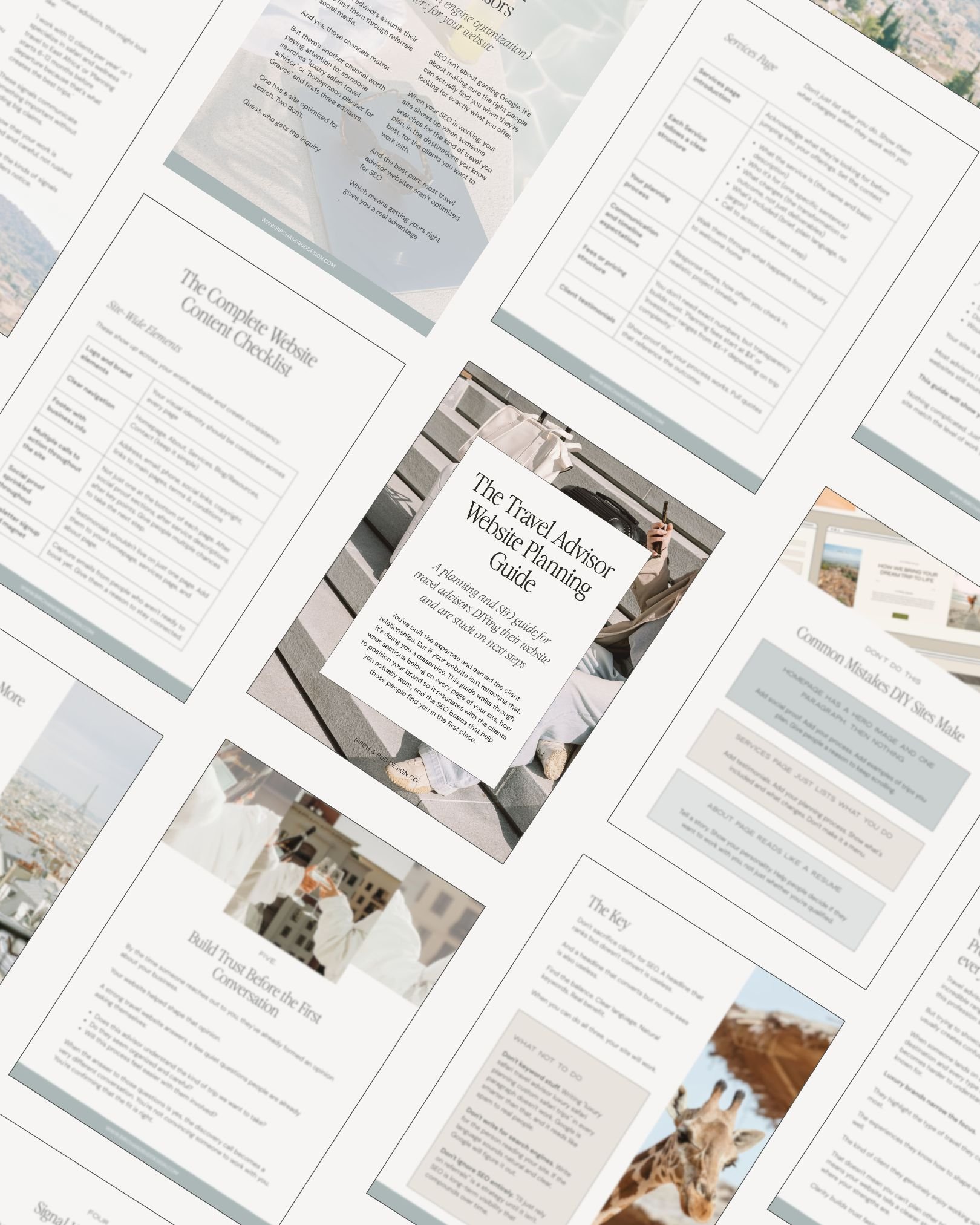
The Website Planning Guide breaks down key sections each website page should have, why they’re important and SEO fundamentals to get found in Google.
Now available in the Shop!
On the Topic of Blogging, Your Blog Posts Should Work Together, Not Independently
Once your specialty pages are built, blog posts work hardest when they orbit those pages rather than sitting as disconnected pieces. This is called a content cluster.
Your specialty page is the hub. Blog posts are the spokes. They all link back.
If you're an Italy specialist:
Hub: your Italy travel planning services page — but a longer Italy blog post can work well here too (~ 5000 words)
Spokes: 'Best time to visit the Amalfi Coast,' 'Italy honeymoon vs. anniversary trip — what actually changes,' 'Getting from Rome to Florence without losing your mind
Each post links back to your Italy page. Google reads that cluster and starts to associate your website with Italy travel expertise. Three disconnected posts on Italy, Japan, and sustainable packing don't do that. A cluster does.
→ For the full picture on structuring your blog for actual traffic: Boost Your Squarespace Blog Traffic With These 5 Must-Have Strategies
PS. Have you noticed all the linking I’m doing in this post to other blog posts & my shop? This is internal linking and doing exactly what I just touched on!
A Word on Backlinks
Backlinks — links from other websites pointing to yours — are one of Google's trust signals. The more credible the source linking to you, the more authority it passes.
You don't need a PR agency. The realistic options for an independent Travel Advisor are mostly things you should already have in place:
Your host agency's advisor directory — if there's a public-facing listing, make sure yours is complete and links to your website
Preferred supplier and consortium partner pages — many have advisor directories. If you're a preferred partner and your website isn't listed, ask
ASTA, ACTA, or TICO directories (depending on where you're based) — professional association listings are low-effort, credible backlinks
Your Google Business Profile and local directories — chamber of commerce, local business associations
Features or mentions in travel publications, local press, or niche blogs — if you've been quoted somewhere, make sure the link back to your website is there
Guest Blog Post on other websites that would attract your ideal clients
None of this requires a budget. It requires being listed where you should already be listed.
Also notable, LinkedIn and Reddit consistently rank among the highest-cited sources in AI Overviews. If you're posting genuinely helpful content on either platform and linking back to your website, you're increasing the chance your expertise gets pulled into those AI-generated answers. These aren't just social media plays. They're feeding the exact sources AI draws from. Optimize both profiles with links to your website too. If you don’t have a website, link to your socials.
And if you can manage it: PR. A named mention in a publication your ideal client actually reads, whether that's a travel supplement, lifestyle magazine, or niche blog, is one of the most effective GEO moves available.
AI pulls from what authoritative sources say about you, not just from your website. One well-placed article or inclusion on a 'best advisors for X' list can do more for recommendation visibility than months of blog posts. Pitching one story angle per quarter is achievable for a solo operator, and it compounds.
What Not to Do
A few things that either don't work or actively make things worse.
Writing blog posts with no target keyword in mind
If you don't know what search term you're trying to rank for before you write the post is effectively invisible to Google. It can be genuinely useful and well-written and still rank for nothing.
Keyword stuffing
The opposite problem. Repeating 'luxury safari travel advisor Canada' in every other paragraph is something Google's algorithm now penalizes. Use your keywords naturally, in the places they belong: the page title, the opening paragraph, a couple of headings, the meta description. That's the whole job.
Publishing thin content just to have something up
A 300-word post with no real depth doesn't rank. Worse, too many of them can dilute your overall domain authority. One genuinely specific, useful post is worth ten filler pieces. This goes the same for pages. Having an FAQ page or a short services page with under 300 words is not doing you any favours. Merge like content or expand with depth.
Using a host subdomain instead of your own domain
If your website URL is 'youragency.com/yourname' rather than 'yourname.com,' the SEO work you do builds authority for the host domain, not yours. Your own domain is non-negotiable if you want to build long-term search equity.
Never updating old content
A post from 2020 with outdated pricing, a closed supplier, or pre-pandemic travel information is still sitting on your website, working against you. Google doesn't reward stale content. A quick annual review of your existing posts saves you more than you'd think.
AI Specific Things You Can Skip Entirely
There's a lot circulating right now about how to 'optimize for AI specifically,' and most of it is either unnecessary or actively a time drain. Google published guidance on this in May 2026, and the answer to most of it is: don't bother.
PS. This is jargony for most people, but I’m adding it in anyway in case it’s relevant for you.
LLMS.txt files
You may have seen people recommending that you create an LLMS.txt file on your website so AI systems can better understand your content. Google has confirmed this does nothing for your visibility in AI Overviews or AI Mode. Skip it.
'Chunking' your content
The idea that you should break posts into small fragments so AI can parse them more easily — also not necessary. Google's systems understand nuance across a full page. Write for your reader, not for a parsing algorithm.
Rewriting your content specifically for AI
Your website doesn't need a special AI-friendly rewrite. AI understands synonyms, intent, and context. You don't need every possible variation of a keyword, and you don't need to restructure your writing style. What you already have, if it's specific and genuinely useful, is what AI is looking for.
Manufacturing mentions across the web
Some services promise to get your brand mentioned across forums, blogs, and directories to boost AI visibility. Google's systems are good at spotting inauthentic signals, and this approach can backfire the same way link schemes did in traditional SEO. Genuine reviews, real PR, and expert contributions are the only version that holds.
Overfocusing on structured data for AI
Schema markup is still worth using for rich results in regular search. But Google has confirmed it's not required for AI search visibility, and there's no special schema that gets you into AI Overviews. Don’t obsess.
What to Actually Expect
SEO is slow. No way around it.
on-page fixes → a few weeks
blog traction → 3–6 months
consistent organic traffic → 6–9 months
Changes you make now probably aren't reflected in real numbers until Fall. That's not a reason to avoid it. It's a reason to start now rather than later.
One thing worth reframing while you track: overall click volume from AI-driven search may be lower than traditional search. Also true is that when people do click through from AI Overviews, they tend to stay longer and go deeper. They've already researched in the summary, so they arrive more qualified. Track time on page and page depth alongside volume. Those numbers often tell a more honest story than raw clicks alone.
It compounds. And unlike ads, it doesn't disappear when you stop paying.
Where to Start This Week
Three things, in priority order
1. Search like your client would
Your specialty and a destination, not your name. Note where you show up, what's being said, and who ranks above you. Then do the same in AI: open ChatGPT, Claude, or Gemini and type the questions your clients are likely asking. See if you come up.
2. Fix your homepage title
If it says 'Home' or your business name, change it. Something like 'Luxury Safari Travel Advisor | [Your Name]' takes two minutes and immediately improves both SEO and the first impression for anyone who lands on your page.
3. Connect Google Search Console if you haven't already
Free, takes ten minutes, and gives you data nothing else can. If you’re on Squarespace, use this tutorial.
If you're working through your website design and want a clear framework for what your core pages and specialty pages need to say, the Website Planning Guide for Travel Advisors is a good place to start - the SEO work compounds when the foundation is right.
Your SEO and GEO Checklist
You'll see 'GEO' (Generative Engine Optimization) used a lot lately, often framed as a separate discipline you need to layer on top of SEO. Google's own guidance is clear on this: optimizing for generative AI search is still just SEO. The same foundations that help you rank in regular search are what help you show up in AI Overviews and AI Mode. The checklist below reflects that.
I've created an SEO & GEO Checklist you can copy for free to get started on your search game!
Here’s your Action Checklist
Your website:
Page titles on all core pages contain a real keyword, not just 'Home' or 'Services'
Meta descriptions are specific about who you help and what you specialize in
URL slugs are clean and keyword-based
Each specialty you offer has its own dedicated page with its own URL
Images have descriptive alt text throughout
At least one piece of content (page or post) built around first-hand experience or specific knowledge — not a round-up or tips list anyone could write
At least one blog post written in the right format: question-led heading, direct answer in first sentence, specific quotable details throughout
Your presence across the wider web:
Google Business Profile complete: service area, keyword-rich description, photos, products
Recent reviews on Google, Trustpilot, and TripAdvisor
Listed in host agency directory, consortium partner pages, and professional association directories
LinkedIn and/or Reddit posts linking back to your website, with an optimized profile
At least one PR pitch sent to a relevant publication or niche blog this year
Measurement:
Google Search Console connected
Long-tail queries driving traffic identified in Search Console
Tested yourself in ChatGPT, Claude, and Gemini — and searched in Google AI Mode — for the questions your clients are likely asking
Tracking time on page and page depth alongside traffic volume
Don't bother with:
Creating an LLMS.txt file
Breaking content into chunks for AI
Rewriting existing content specifically for AI systems
Paid services that promise AI mentions or citations
Want a thorough SEO setup guide? Check out the SEO Website Setup in the Shop!
FAQ
Can I do SEO on Squarespace?
Yes — Squarespace has everything you need: page titles, meta descriptions, URL slugs, image alt text, and a solid blogging setup. It's not as flexible as WordPress, but for how most independent Travel Advisors use their websites, it's more than sufficient. Download the free version of SEOSpace to run some initial checks.
How long does SEO actually take for a travel advisor website?
On-page fixes can shift things within a few weeks for pages Google is already crawling. Blog content targeting lower-competition keywords typically starts gaining traction at three to six months. Meaningful organic traffic from a consistent strategy usually shows up around six to nine months in. Not fast. Still worth starting now
Is Google Business Profile worth it if I work from home?
Yes. You can set a service area instead of listing a physical address, which keeps your home private. Someone searching 'travel advisor [your city]' will see your profile in the map results — and those sit above regular organic results on mobile. Set it up, fill everything in, and ask a few past clients for a review. Note, Google has made this harder for home addresses, but keep at it!
Do I need my own domain for SEO to work?
Non-negotiable. If your website runs on a host agency's domain rather than your own, every bit of SEO work you do builds their authority, not yours.
How many blog posts do I need before SEO starts working?
There's no magic number. Five well-targeted posts built around what your ideal clients are actually searching for will outperform fifty vague ones every time. Depth and relevance beat volume.
Should I write about my specialty or cover a broader range of topics?
Your specialty, every time. A post about planning a first safari in East Africa will bring better-fit clients than one about 'top travel destinations for 2026.' The wider the topic, the more competition you're walking into.
Do I need to create an LLMS.txt file or do anything special for AI?
No. Google has confirmed that LLMS.txt files, content chunking, and AI-specific rewrites don't improve your visibility in AI search. The content that ranks well in regular search is what gets cited in AI Overviews. Focus on the SEO fundamentals in this post and write genuinely useful, specific content. That's it.
Do I need to hire an SEO expert?
Not to start. The highest-impact work — page titles, Google Business Profile, targeted blog content — is entirely doable without technical expertise. Where an expert genuinely adds value: technical issues you can't diagnose in Search Console, or managing content strategy over the long term. Get the basics right first, and if you have Squarespace, run a free report with SEOSpace to start.
What's the single most useful thing I can do today?
Connect Google Search Console if it's not already set up. Everything else is guesswork without it. It shows you what people are already searching to find you, which pages are almost on page one, and where the actual opportunities are. Free, ten minutes to set up.
Need a Hand Getting Sorted?
If you’re struggling with SEO, you can book in a Design Day to knock design or SEO bits off your to-do list or an hour a Strategy Call to get clarity on your direction. Or, start from the foundation with an SEO optimized custom or semi-custom website for your travel business. Feel free to connect, and we can see what that looks like for your goals!





Almost everything written about SEO for travel websites is written for booking platforms. Here's what actually works for independent Travel Advisors, and where to start, especially if you’re using Squarespace.