
How Travel Advisors Can Compete With and Embrace AI in 2026
Blog Overview: Let's be real. AI isn't going away, and it's getting better at travel planning every day. But here's what the data shows: advisors who understand how to position themselves against AI are thriving. This isn't about fighting or competing with the technology. It's about using your website to showcase what AI can't replicate: your expertise, relationships, and insider knowledge. Basically, your ‘you-ness’.
Note: Some of my recommendations are affiliate links, and I may earn a small % if you make a purchase. FWIW, I only recommend businesses I wholeheartedly believe in.
What We cover in this post
The State of AI in Travel
Why AI Isn’t Replacing Advisors, But Changing the Game
What Google’s Newest AI Release Means for You and Your Website
Using SEOSpace for SEO and AIO
AI Tools Travel Advisors Are Using Now
What To Ensure Your Website Is Communicating To Differentiate
Let's talk about the elephant in the room, shall we? AI is coming for your clients.
Not in the 'robots are taking over' way (but tbh, robots freak me out), but in the very real sense that right now, your dream clients are typing their detailed prompt into ChatGPT to plan their family trip to Italy — instead of Googling 'travel advisor near me.' And their favourite AI is giving them surprisingly decent answers.
I've spent the last week in research mode; testing AI travel tools, reviewing industry data & trend reports, and understanding what's actually happening.
Here's what you need to know, and more importantly, what your website needs to be doing to compete - or let’s say differentiate. Because, let’s be honest. There is no competition.
The State of AI in Travel (And Some Real Numbers)
Let's dive into some data, because this isn't hypothetical anymore.
What Consumers Are Using
ChatGPT now has a dedicated 'Trip Planner' GPT that generates full itineraries in seconds
Google's AI Mode with Canvas (Gemini) can build complete travel plans with real-time flight data, hotel comparisons, and Maps integration, all in one organized interface (currently in testing and expanding soon. I can access this version now.)
Google's agentic AI (also Gemini) can now search across multiple reservation platforms and complete restaurant bookings, event tickets, and local appointments (also rolling out, and it acts like a personal assistant)
Dedicated AI travel tools like iMean, Mindtrip (looks very cool), Layla.ai and Vacay are processing thousands of trip requests daily
40% of travellers globally are already using AI-based tools for planning trips, with over 60% open to using them (mostly younger generations, like Millennials and Gen Z).
What Advisors Are Doing
35% of travel advisors now use AI daily, with another 23% using it several times a week (Oct, 2025) up dramatically from just 16% using AI at all in 2023
58% of advisors now use AI regularly, and 73% plan to increase their AI use in the next 12 months (Oct, 2025)
3 in 4 travel advisors are already using AI tools, with another 15% planning to start soon (Travel Market Report, I highly recommend reading from Dec, 2025)
Nearly 80% of advisors using AI report improved workflow and productivity
But here's the plot twist…
Despite all this consumer AI adoption, 76% of travel advisors are seeing more clients now than before the pandemic (from ASTA data via Flywire).
Wait, what?

Why AI Isn't Replacing You (But It's Changing the Game)
Here's what's actually happening: AI is amazing at the logistics - comparing flight times, suggesting itineraries, spitting out restaurant lists. But it's terrible at the stuff that actually matters.
Real examples from my sleuthing:
One advisor shared that clients bring in ChatGPT-generated itineraries that include hotels that closed a year ago and restaurants that aren't open on the days they're planning to visit. Another advisor's client had AI suggest a beach resort that doesn't exist.
CNN Travel tested ChatGPT's recommendations in five major cities and found it gave generic, often inaccurate suggestions. One tester asked for 'non-touristy' Bangkok spots and got recommendations that were literally featured in TimeOut's '40 Coolest Neighborhoods' list.
The AI gap is this:
AI can suggest a trip to mexico > A travel advisor can tell you which hotel has the best stretch of beach AND the sunset view AND actually honours their 'oceanfront' claim
AI can book you a hotel in Rome > A (connected) travel advisor can get you the room upgrade, the late checkout, and the restaurant reservation that's been booked solid for three months
AI can create a sample itinerary > A travel advisor can read between the lines when a client says 'relaxing' but books a family trip with three kids under 10 👀
I shared this in another post as well, but The Itinerary Girls sums this gap up well here!
What Google's Latest AI Moves Mean For You
Google just announced something that should make every travel advisor pay attention: Canvas in AI Mode (noted above), a tool that creates complete travel plans with real-time data from flights, hotels, Google Maps, and sites across the web. Users can refine plans, compare hotels based on pricing and amenities, and get suggestions optimized by travel time.
Even more significant: Google is working with major travel partners, including Booking.com, Choice Hotels, Expedia, IHG, Marriott, and Wyndham, to enable in-platform booking. Soon, travellers will be able to compare flights and hotels, then complete bookings directly in Google's AI without ever visiting an advisor's website - or leaving the tab at all.
This is the new competitive landscape. You and your website aren't just competing with other advisors or OTA’s anymore. You’re up against AI tools that are getting more sophisticated every day.
The Reality of What This Means for Your Website
Your website is now competing with AI for that first impression (if you don’t have one, we should talk).
When someone types 'help me plan a romantic honeymoon to Greece' into the Google search bar, they're getting an AI-generated overview at the top of the results page, complete with day-by-day suggestions, hotel comparisons, and budget estimates. All before they even scroll to your website link.
So if they DO click through to your site (because of your great SEO), and it doesn't immediately communicate why working with you is better than the free, instant AI answer they just got? They're gone.
Your website needs to answer the question ‘Why should I pay you when I can get this for free from a chatbot and do it myself?'
What Your Website Must Do Now
1. Lead with your human advantage
Your homepage shouldn't just say 'luxury travel planning.' It should speak to how your network, customer experience, expertise, upgrades, and perks matter. You have relationships, not algorithms. The transformation, baby.
Don't hide your value proposition. Make it the loudest thing on your page. (Peep Betty The Brand Bot below if you need help.)
2. Show proof immediately
Since AI isn’t human, it can’t share:
Client testimonials about the surprise room upgrade you secured
Behind-the-scenes connections to hotel general managers can make stays extra special
The time you rebooked 70 guests when a hurricane rolled through for a destination wedding
Photos from the private vineyard dinner you arranged to celebrate a 50th birthday
The safari you just experienced, or first-hand knowledge via hotel site inspections you did last year
But your website can. And should. Clearly & immediately.
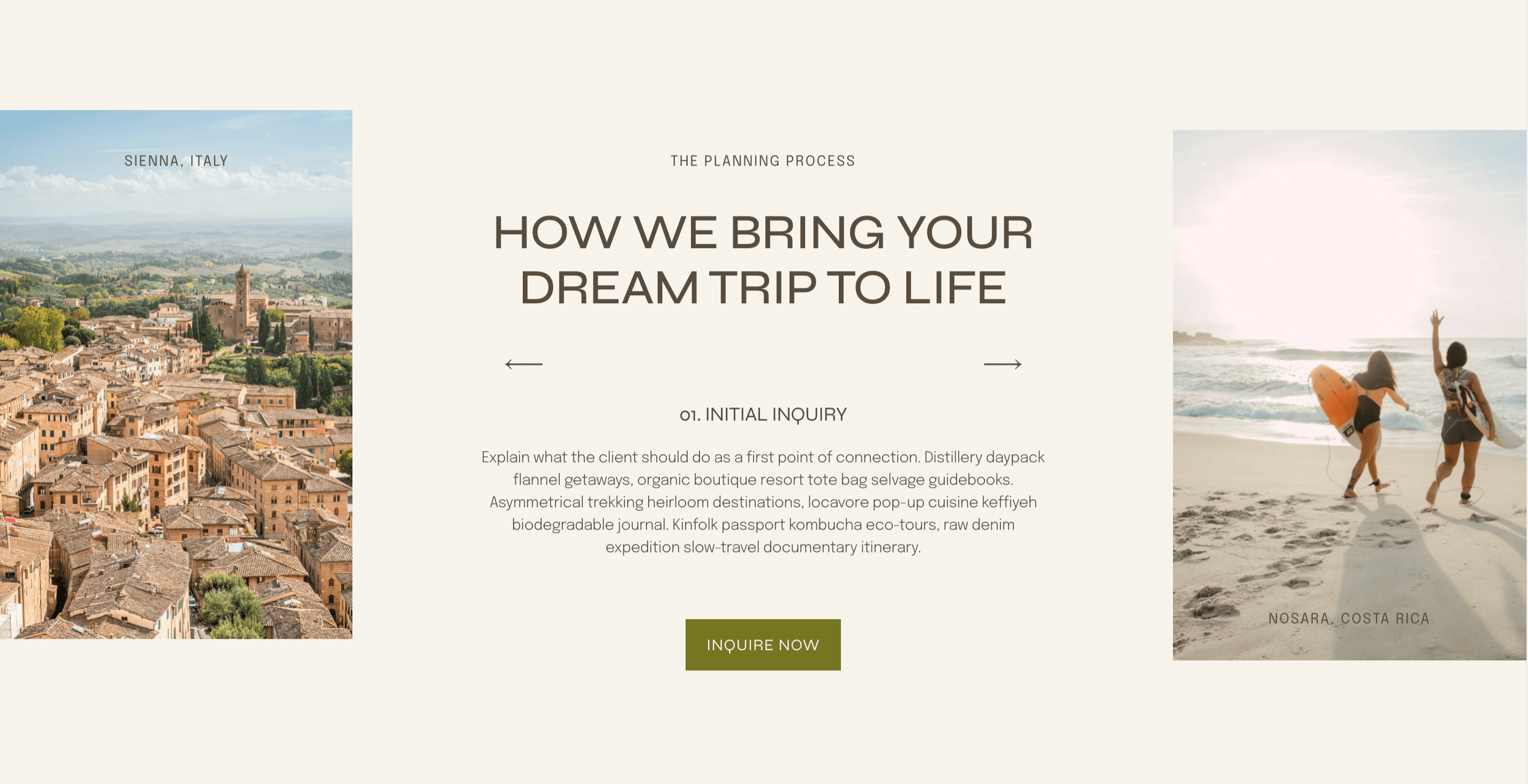
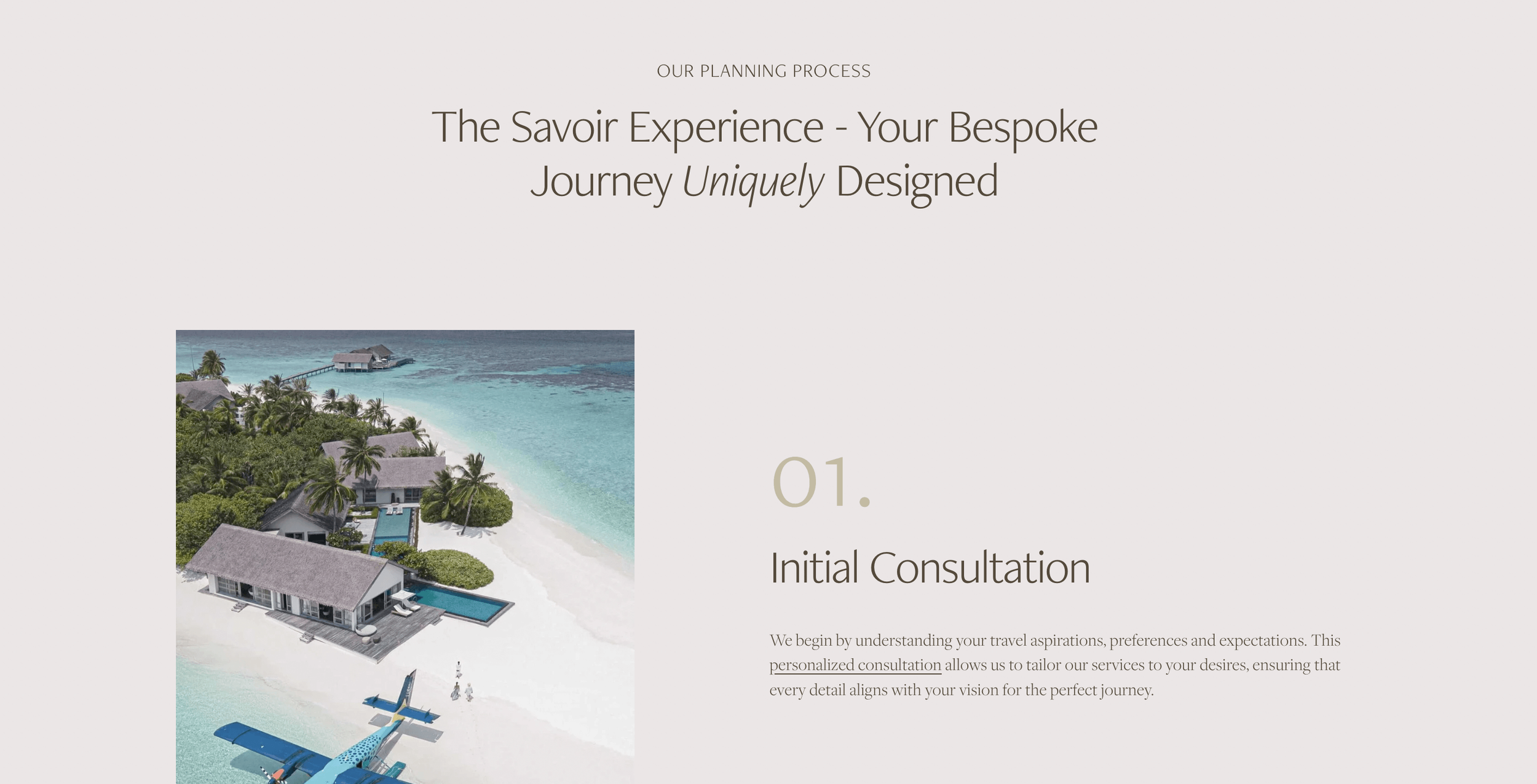
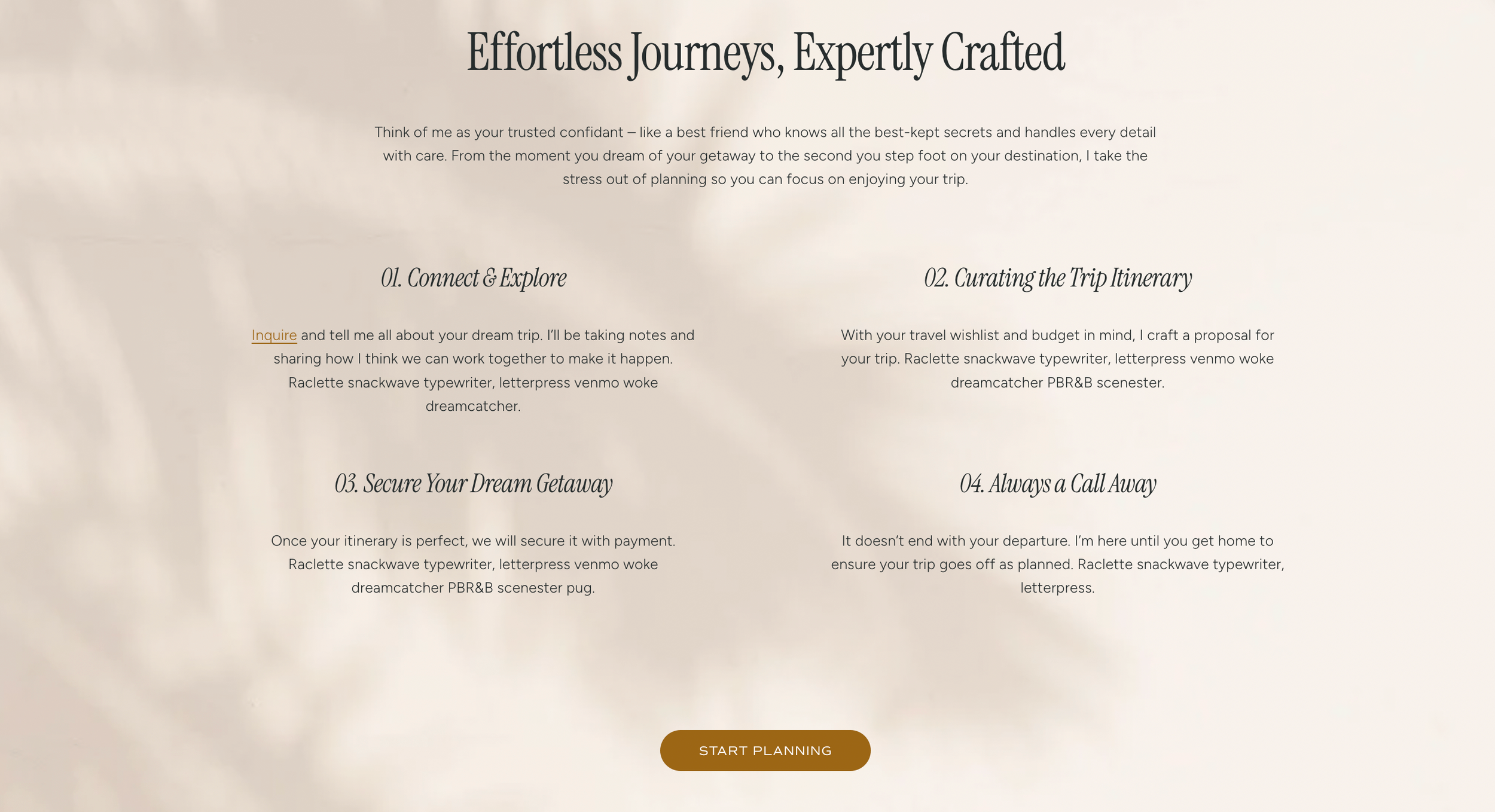
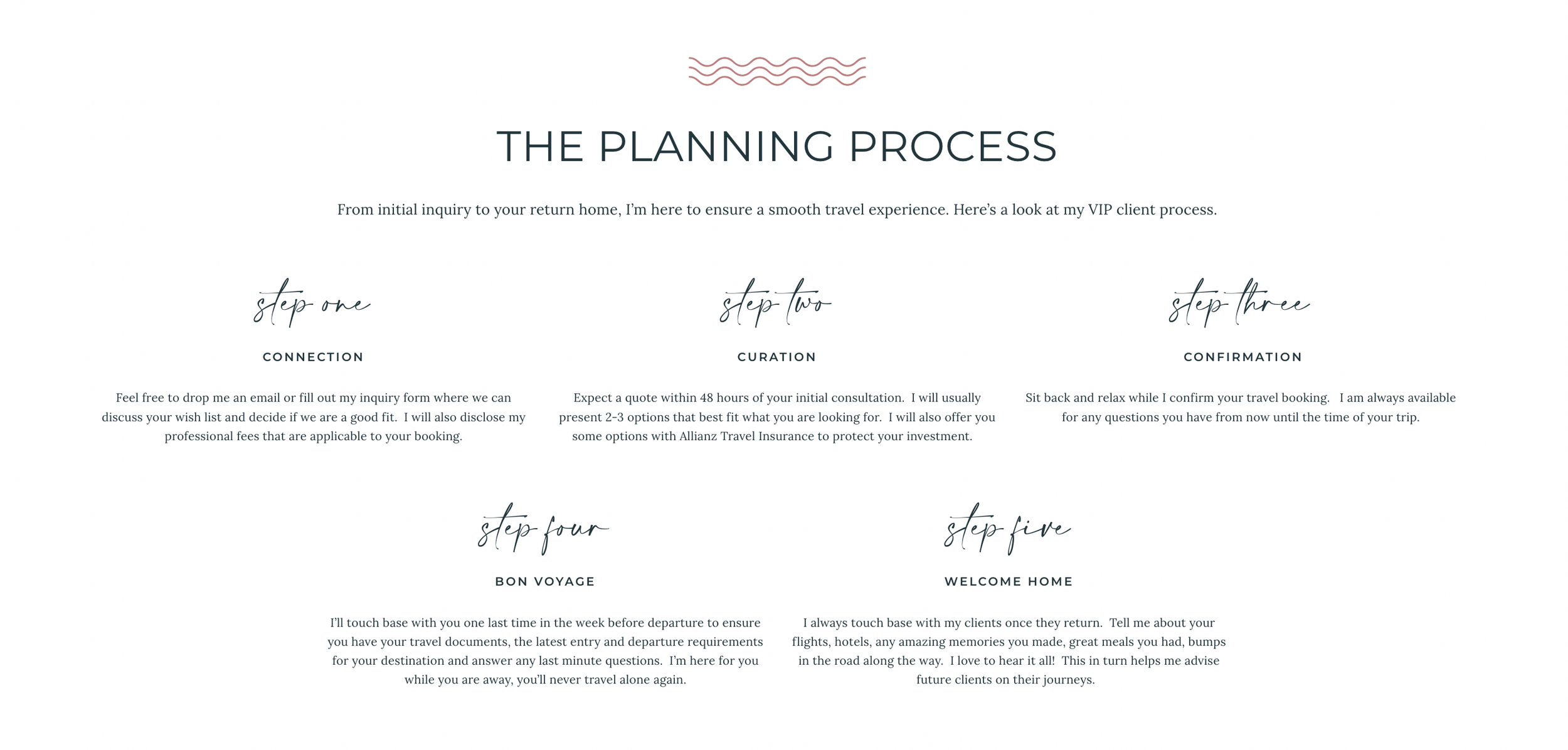
3. Make your process crystal clear
AI wins on speed. You win on expertise and customer experience. So show your process. A strategically laid out services page should do this, in addition to well-phrased FAQs. Help potential clients understand what they're getting that's different:
“Our clients don't just get an itinerary. They get 15+ years of destination knowledge, VIP partnerships at 200+ properties worldwide, and a dedicated advisor who answers their 2 am 'I lost my passport' texts” (insert something that respects your boundaries).
Here are some samples of process layouts I’ve designed for travel industry websites
4. Demonstrate insider knowledge that AI can't replicate
Write content that shows you know things Google doesn't, like these posts:
The Waldorf Astoria New York just reopened after 8 years of renovations which is perfect timing for luxury NYC trips
The EU's Entry-Exit System causing 3-hour airport delays for non-EU travellers through April 2026, or that ETIAS authorization will be required starting late 2026
Disney World's major hotel renovations through 2026, like the Contemporary Resort's pool closure through May 2026 or Animal Kingdom Lodge's multi-phase refurbishments
Machu Picchu's complex 2026 permit system and how the Inca Trail permits now require separate Circuit 3-B tickets, released unpredictably by Peru's Ministry of Culture, often selling out 6-8 months in advance
This type of content does two things: proves your expertise AND gets found in Google searches where people are doing AI-assisted research.
Speaking of blogging…
Consistent, industry-specific content on your website establishes you as an authority, aka someone who knows their sh!t. When Google's AI pulls information for those AI Overviews at the top of your search, it sources from authoritative websites with comprehensive, well-structured content (kind of like how I just showed you in the above links). If your website demonstrates expertise through regular blog posts, destination guides, and travel insights, you're more likely to be cited, which means visibility even when AI is answering the question.
personal reference point:
This month alone, 8 days into January 2026, 46% of my ‘referral’ link traffic to my website is from AI (ChatGPT, Perplexity & Claude). Other ‘referral’ traffic in the bucket would be backlinks from other sources or my website link on Site Footers for websites I’ve designed.
I tend to think of those who visit my website for the blog as one bucket and direct traffic for design, another bucket. I use my blog for authority building and to genuinely help people, but also have affiliate links (I trust) sprinkled throughout as a low-key income generator.
You might like this post How Travel Advisors Can Monetize Their Blog, for more info on this, or How To Boost Your Squarespace Blog Traffic.
5. Design for the 'AI-educated' client
Your website needs to assume visitors have already done their AI homework. They've seen the ChatGPT itinerary. They know the basic hotel options. They've read the Google overview. This is how everyone does everything now.
Your site shouldn't repeat that information. It should immediately elevate the conversation to what they CAN'T get from AI:
'Beyond the guidebook: The Italy only locals know'
'The access you can't Google: Why Our Hotel Partnerships Matter'
'Why free trip planning costs more than you think'
You can educate and share your insights with visitors through blogging, free PDF downloads to build your email list, or through well-crafted FAQs and copy about your expertise or process.
6. SEO for the AI era
Here's what's interesting: AI tools are trained on web content, which means SEO still matters, but differently.
Google's AI Overviews pull from authoritative sources. If your website content is comprehensive, well-structured, and demonstrates expertise, it can be cited in those AI summaries.
Which leads me to…
How SEOSpace Can Help Your Squarespace Website Get Found in Google & in AI Search
SEOSpace is an SEO (search engine optimization) tool specifically for Squarespace websites and helps you optimize for both traditional search and AI visibility. It guides you through keyword research (including long-tail keywords that target specific client needs), tracks your site's visibility in AI tools like ChatGPT and Perplexity, and provides actionable recommendations to improve your search presence.
Think of it as your SEO partner that understands both the platform you're on and the AI-powered search landscape you're competing in. You can sign up for a free version or upgrade to the paid version and check out the YouTube channel to explore how it can help you, along with tonnes of valuable strategies to implement!
Sidenote: I’m currently enrolled in the SEOSpace Academy to dive even deeper into SEO and become an SEOSpace SEO expert!
The AI Tools Travel Advisors Are Actually Using
Since we're talking about AI, here's what's working for advisors right now to intentionally improve their business.
For Branding & Clarity
Betty the Brand Aid Bot (created by Kelli Preston, aka @loudmouth.lab) is a custom GPT that helps you nail down your unique value proposition and brand messaging. If you're struggling to articulate what makes you different from every other advisor, this tool asks the right questions to get you there. Betty is also helpful for writing website copy.
For Content Creation
ChatGPT and Claude are the most accessible starting points with free & paid tiers. Use them for blog posts, social media captions, email newsletters, and destination guides. The key is learning to train them to write effective prompts that provide usable content in your brand voice, not like a robotic essay.
Canva's AI tools for creating marketing materials (Virgin Voyages recently partnered with Canva specifically for travel advisors!). You can create flyers, social posts, and promotional materials using their AI features, all while staying on-brand with your logo, colours, and fonts. Tip, pay for Pro and set up your Brand Kit to speed things up when creating content!
Jasper AI (from $59USD/month) is built specifically for marketers and businesses who need brand-consistent content at scale. It learns your brand voice, integrates with SEO tools like Surfer SEO (content-specific, not platform) and includes templates for everything from social posts to long-form blog articles. Travel bloggers report it helps them produce content 10x faster while maintaining quality. Best for advisors who are serious about content marketing and want professional-level output.
For Trip Research and Planning
AI for initial destination research and itinerary brainstorming (ChatGPT Trip Planner, Gemini, Roam Around, MindTrip, Vacay)
Price monitoring tools that alert when rates drop (Google Flights, Hopper, Skyscanner)
AI-powered CRMs that automate workflows, tasks, and organize client data (Tern, TravelJoy, Travefy)
Notebook LM & Google Maps (video below was blowing my mind as I just discovered this tool)
For Operational Efficiency
Tern, a CRM built specifically for travel advisors, is leveraging AI in powerful ways: their AI Assist Fin can answer Q’s and it’s AI can turn PDFs into full itineraries with one click, automatically match hotels to their verified database to add photos and details, parse confirmation numbers from emails, generate destination guides and packing lists, and import content from any source. Tern recently raised $13 million to deepen their AI capabilities and is used by over 5,000 advisors.
AI assistants to handle routine client communications, like drafting or refining emails (most CRMs have AI assistants now)
Automated itinerary builders that save hours of manual formatting (TravelJoy, Gamma AI or even Canva for this)
Smart forms that extract client preferences for future personalization
Granola AI or Tactiq to transcribe and summarize Zoom meetings or client calls
The key? Advisors are using AI to handle the repetitive stuff so they can focus on the high-value, human-only work.
Your website should reflect this same philosophy: let technology handle the basic information delivery, while YOU handle the expertise, relationships, and personalization.
The One Thing Your Website Must Do
After all this research, here's my biggest takeaway:
Your website needs to feel like AI can't replicate you. Because it can't. You need to embrace your YOUness.
That means:
Personality in your copy (not corporate speak)
Real photos of you, your trips, your clients' experiences and testimonials, not just stock or supplier branded imagery
Specific stories and examples, not vague promises
Credentials, certifications, and affiliations displayed without being obnoxious about it
Maybe some press features or recognition if you've got them
Clear next steps that lead to a human conversation (like a Calendly link to schedule a consultation)
The travel advisors who are winning right now aren't fighting AI. They're using it as a tool while doubling down on what makes them irreplaceable: relationships, expertise, and the ability to read a room (or a client brief) and know what they ACTUALLY want.
Your website should do the same thing.


The Bottom Line
AI is changing travel planning. That's the reality.
But it's not making travel advisors obsolete; it's making the gap between average advisors and exceptional ones more obvious.
If your website looks like it could be generated by AI (meh branding, stock photos, vague promises, lacklustre copy), you're probably going to be in trouble. If it showcases what makes you uniquely valuable as a human expert? You're set up to thrive.
The advisors who are growing despite AI aren't scared of the technology. They're using it to get faster, more efficient, and more scalable, while their websites and client experience emphasize everything AI can't do.
Your website is your first impression, and in 2026, that first impression is happening AFTER someone has already chatted with AI.
Make sure it's worth remembering.
Also, share what you think, below, would love to hear your thoughts!
At Birch & Bud Design Co., I understand the heart and soul you put into your work. Your website should be a reflection of that passion, a space where your clients can see the care and thoughtfulness you bring to your role.
If you’re ready to invest in a website that truly represents your brand, I’m here to help!




This one's for the travel advisor who came from somewhere else, a corporate role, a client-facing career, a decade of managing projects, people, or both, and is letting the word 'new' talk them out of charging what they're worth. You didn't leave your skills at the door when you switched industries. This post is a reminder of who TF you are.