
Why Would Someone Choose You? How Travel Advisors Can Craft a Position That Actually Sticks
Blog Overview: Most travel advisors can describe what they book. Fewer can explain clearly why a client should choose them specifically. This post breaks down what positioning really means, the different ways you can build one without narrowing your business too far, and the questions worth sitting with to find your honest answer.
What happens when someone asks why they should choose you?
Picture this: you're on a discovery call, things are going well, the client seems genuinely interested, and then they ask it. 'So what makes you different from other travel advisors?'
And you pause, maybe internally panic. Maybe you can list a few things. Years of experience. Great supplier relationships. The fact that you really care. All true. All things that every other advisor is also saying.
That pause is a positioning problem. Confidence and scripts are symptoms; the root of it is that you haven't yet landed on a clear, honest answer to the most important question in your business: why would someone choose you, specifically, over anyone else?
The good news is that's a question you can actually answer. And you don't need to overhaul your business or turn away half your clients to do it.
What 'I book all types of travel' is actually communicating
When an advisor says they book all types of travel for all types of clients, the instinct makes sense. You don't want to turn business away. You're capable of handling a wide range of trips. Why limit yourself?
What actually happens is the opposite of what's intended.
Staying general doesn't keep your options open. It makes you harder to find, harder to remember, and harder to refer. When someone asks a past client ‘Who do you use for travel?' the answer needs to be specific enough to pass along. 'She's really good' doesn't get you a referral. 'She planned our whole trip to Italy, every detail handled, nothing left for us to figure out', does.
It also affects your fees or your ability to articulate and charge them with confidence. When a client can't understand what makes you the right person for their trip, your fee feels like a number rather than an obvious part of working with someone who knows what they're doing. When they can, it doesn't.
And it affects the potential of your supplier relationships. Advisors who sell a product often and are known for something specific get noticed differently: better access to FAM trips, invitations to specialist events, BDMs who remember who they are and bring them in when something relevant comes up. PS. Register for alll the loyalty programs so your bookings are registered with resorts & hotels!
Vague advisors compete on price. Advisors with a clear position get found, trusted, and paid.
You don't need a niche — you need an answer
And that’s both true and not. I am a BIG proponent of niching; however, this is where a lot of advisors get stuck because the conversation around positioning almost always slides into niching, and niching can feel restrictive, scary, or just not right for where you are in your business.
So let's be clear: having a position doesn't mean having a narrow specialty. A niche is one way to answer the question ‘Why would someone choose you?' It's not the only way.
1 - How You Work
Some advisors are positioned entirely around their process: everything is handled, nothing falls through, the client never has to chase anyone down or wonder what's happening. That's a position. It speaks directly to a specific kind of client without limiting the trips you book at all. This is especially common in the luxury space.
Most clients have no idea what goes into a well-planned trip, so if your position is your process, making that invisible work visible is what sets you apart.
'I work with people who want the whole thing managed, from flights to dinner reservations to what to do if something goes sideways. They're not looking for suggestions. They want it handled by someone someone who’s obsessed with details as they are.'
2 - Who You Work Best With
This isn't about only booking one type of trip. It's about the kind of person you do your best work for or absolutely love to work with. Busy professionals who want zero involvement in the planning. Families who travel together every year and need someone who understands the complexity. Couples who are finally taking the trip they've been putting off and want it to be exactly right.
'My clients are usually people who've tried booking things themselves and realised it's not actually easier. They just want someone they trust to handle it properly.'
3 - What You Stand For
Some advisors are positioned around a point of view: they only work with clients who value expertise, they don't do order-taking, they're the advisor who tells you honestly if a destination isn't right for what you're describing. Or, maybe you won’t book 3* resorts out of principle or work with clients who value sustainability and transformational travel with B Corp-only suppliers. That itself is a position, and it attracts clients who are specifically looking for it.
'I'm not the right fit for everyone, and I'm okay with that. The clients I work best with want real advice, not just someone to process a booking.'
4 - A Specific Area of Knowledge
Knowing a destination or product category deeply, and being known for that knowledge, is also a form of positioning, even if you're not turning away everything else.
'I know France & Italy well, particularly independent travel where the itinerary needs to actually work on the ground, not just look good on paper.'
The point is that positioning is about being recognizable and specific, not about building walls around what you'll book. You're looking for the answer that's already true about how you work, what you value, and who you serve best, and then saying it clearly enough that the right people can find you.
Questions to ask yourself to get to the root of your difference
You don't need to manufacture a position. Most advisors already have one; they just haven't put language to it yet. These questions help you see what's already there.
It might feel like homework, but write down the answers rather than just think through them. What ends up on paper is usually more honest than what stays in your head.
1. What type of travel do you know the most about right now?
From your own experience or learning, your existing bookings, and your supplier relationships. Where have you spent enough time that you could answer almost any question without looking it up? This does not mean you need to know everything — that’s impossible. It’s about knowing more than your client and/or being resourceful enough to find the answers to questions you don’t know.
2. What trips do you find yourself drawn to even when no client is asking?
The product categories you keep reading about, the FAM trips you actually want to do, the destinations you bring up unprompted. That's pointing at something worth paying attention to. Booking what you love is kind of the whole point.
3. Who have your best clients been, and what did they have in common?
Not just what they booked, but how they approached the process, what they valued, and why the working relationship was easy. The patterns there are usually telling.
4. What's a problem you solve that a client genuinely couldn't solve on their own?
Not 'I find great hotels' — anyone can do that with enough time. What do you know, from experience or from relationships, that isn't available to someone who just searches for it? Or, at least without a lot of effort.
5. How do clients who loved working with you describe the experience?
Not the trip itself, but the experience of working with you. What do they say? Is that what you'd want to be known for?
PS. If you need help with your client feedback questions, you might want my Travel Advisor Feedback Framework — it’s free. So fun.
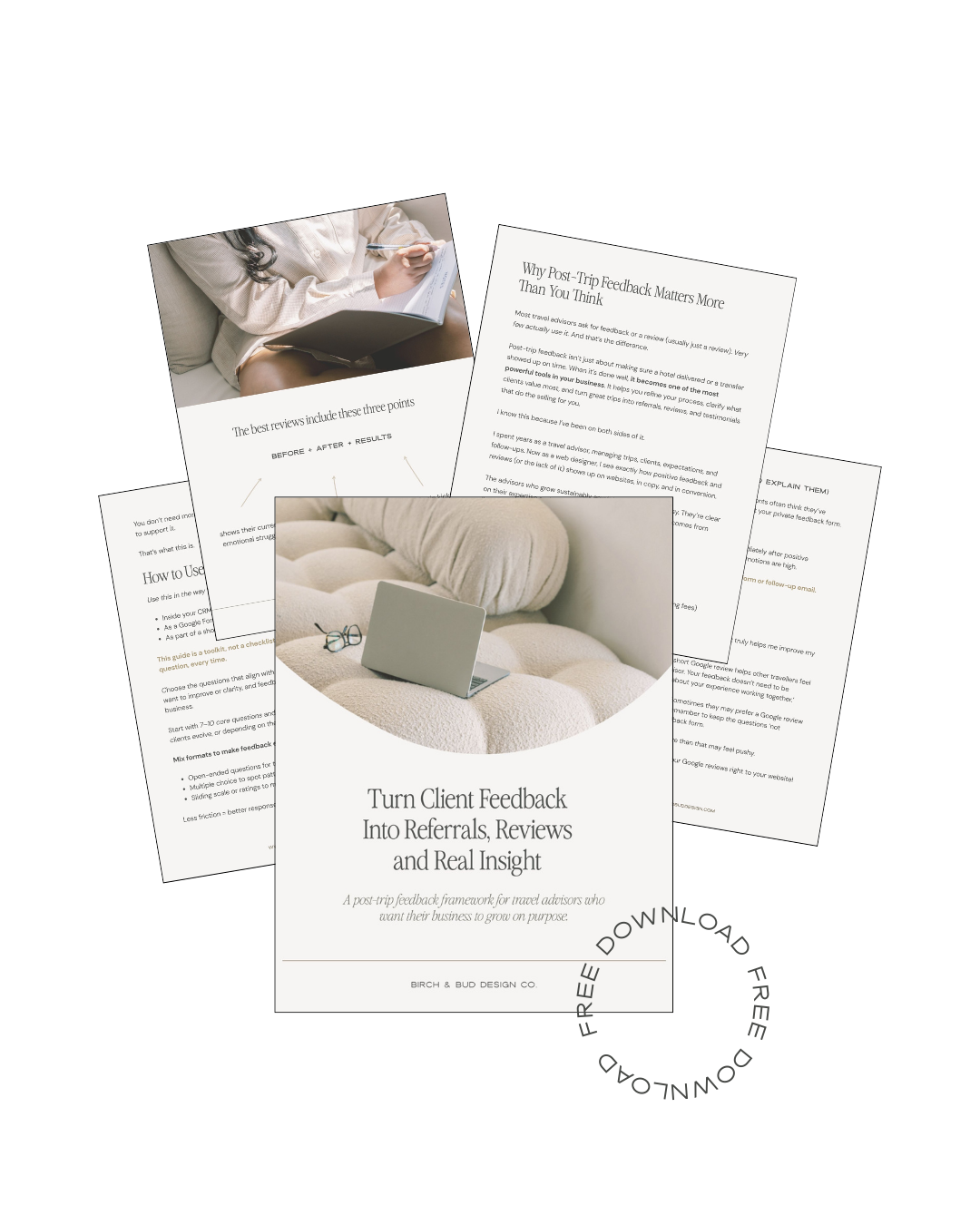
Ask better questions, get more meaningful responses, and turn what clients tell you into something actually useful
If your feedback process feels inconsistent, awkward, or underused, you’re not alone. The Travel Advisor Feedback Toolkit might be just what you need!
Stumped?
If you're sitting with these and drawing a blank because you're still early in your business, the answer isn't to wait.
Do the FAM trips available to you
Use the supplier training your host or consortium provides
Book something yourself in a category you want to understand better
You build positioning and knowledge at the same time by doing the work and paying attention as you go. At some point, you'll look back and realize you've had a position for months without having named it yet.
The key - BE RESOURCEFUL AND TAKE INITIATIVE WITH YOUR OWN LEARNING.
What it sounds like when you say it out loud
Getting clear on your position is one thing. Saying it in a way that actually lands, whether that's on a call, in a bio, or when someone asks what you do, is another.
It doesn't need to sound like a rehearsed pitch. It needs to be honest and specific enough that the right person hears it and thinks 'that's me.'
A few examples across different types of positioning:
Process-Based (How You Work)
'I send a full trip brief before I start planning anything. My clients know what's happening, what's coming next, and what I need from them at every step. I don't want anyone wondering where things are at.'
'My process is pretty structured, and that's on purpose. I do the deep research upfront so by the time I'm presenting options, I've already vetted everything. My clients aren't choosing between ten random hotels. They're choosing between three that I'd actually book myself.'
'I build in a proper pre-departure touchpoint, about two weeks out, where I walk through everything. Documents, timing, transfers, the little details that make the difference between a smooth trip and a stressful one. Most advisors skip that part. I don't.'
Client-Type (Who You Serve)
'I work mostly with families planning those bigger trips, the ones with too many moving pieces to manage on your own and too much riding on it to wing it.'
'My clients are usually people who've tried the DIY route and realized it's not actually saving them anything. They want someone who knows what they're doing and will just handle it.'
'I tend to attract couples in their 40s and 50s who've done the all-inclusive thing and are ready for something with a bit more depth. They're not looking for a deal. They're looking for someone who gets what they're after.'
Point-of-View (What You Believe)
'I'm not the advisor for everyone, and I'm honest about that. The people I work best with want real recommendations, not a list of whatever's trending on social media right now.'
'I think the best trips are the ones where you come back feeling like you actually experienced something, not just checked a destination off a list. That shapes how I plan.'
'I believe charging a planning fee is one of the most important things you can do for your business and for your clients. It sets the tone for the entire relationship, and the right clients respect it.'
Niche-Based (What You Specialize In)
'I specialize in independent European travel, the kind where the itinerary needs to actually work on the ground, with enough flexibility built in that nothing feels rushed.'
'My focus is multi-generational travel. Grandparents, parents, kids, sometimes all under one roof. I know how to plan for different energy levels, different interests, and the logistics that come with a group that big.'
'I plan accessible travel. That means knowing which properties actually have the accommodations they claim to have, which transfer companies can handle mobility equipment, and which experiences are worth it when you're working with specific physical needs.'
Blended (Multiple Types at Once)
'I work with busy professionals who don't have 20 hours to research a trip but care enough to want it done well. My process is designed around that. I do the heavy lifting, keep communication simple, and make the whole thing feel easy from their end.'
'I plan honeymoons and milestone trips, but the way I do it is what sets me apart. Every itinerary gets a day-by-day walkthrough with me before departure. I want my clients to feel completely prepared, not just booked.'
None of these are perfect. They're real. And real is what works.
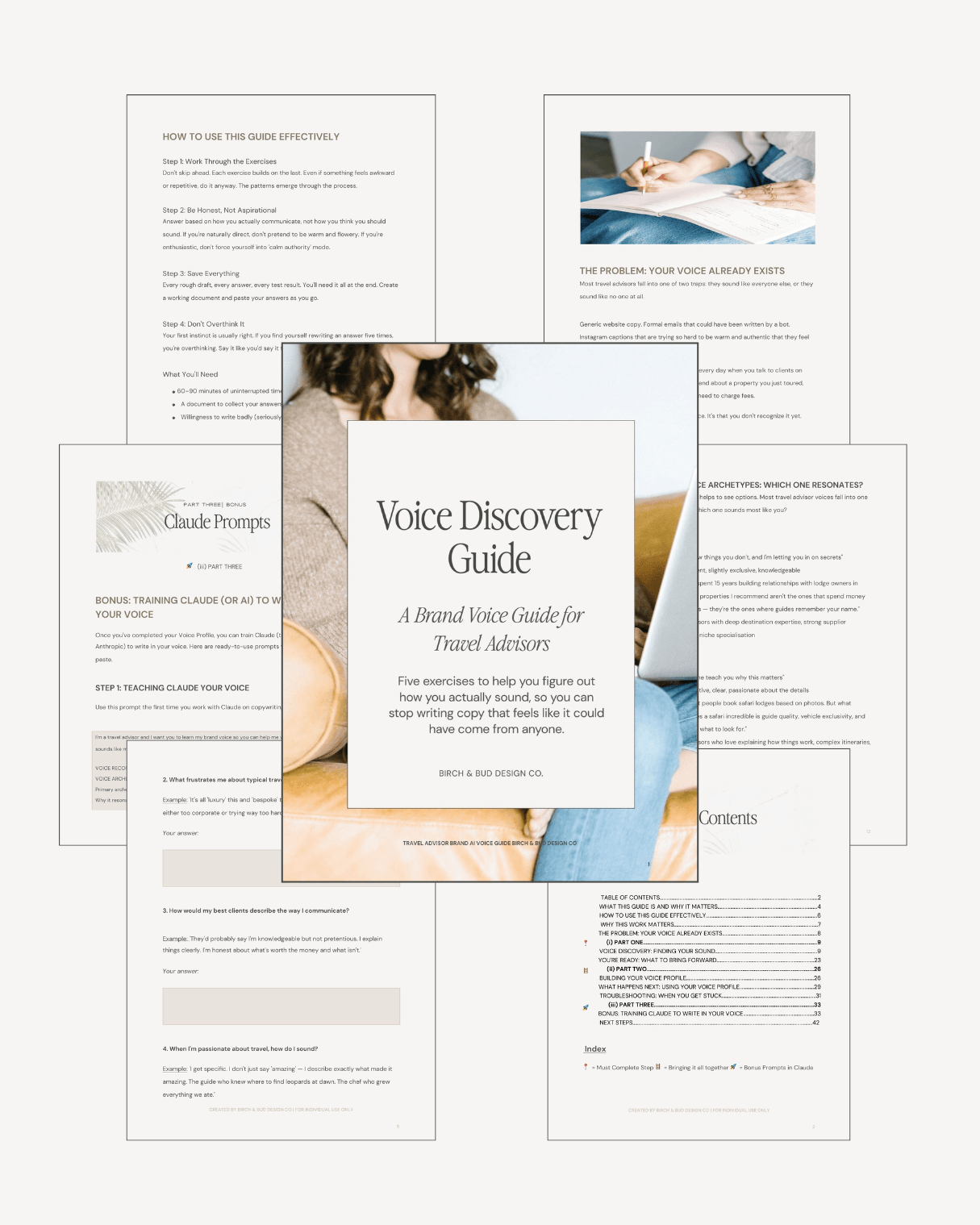
The Voice Discovery Guide for Travel Advisors
This guide walks you through five exercises designed to help you identify how you actually communicate — your natural tone, the words you reach for, the things you say that nobody else would say quite that way. It's the work you do before you write anything.
How to start putting this into practice
Start with the questions above, and actually write the answers down. Then look at what you're already putting out into the world. Your bio, your website, your social content: does it say something specific about who you are and who you work with, or is it still trying to speak to everyone?
Then start saying it out loud. On calls, in how you introduce yourself, in how you talk about your work. Positioning gets clearer through use, and the more you say it, the more you'll notice whether it's landing or needs adjusting.
And if the place where your positioning is getting lost is your website, that's worth taking seriously. Your website is usually where a potential client decides whether you're the right person for them, and copy that tries to speak to everyone ends up resonating with no one.
The one decision that shapes everything that follows
A lot of advisors are waiting to feel more established before they get specific about who they are and what they stand for. It works the other way around. Getting specific is what makes you feel established, because it starts attracting clients who already understand your value before the first conversation, and that changes everything about how those conversations go.
When clients arrive already knowing why they chose you, the fee conversation is easier. The referrals are better because people are passing your name along with actual context. The supplier relationships get stronger because you're building a reputation rather than just a random booking history.
None of that starts with waiting. It starts with finding your honest answer to the question every potential client is asking: why you? — and being specific enough about it that the right people can actually find you.
You don't need a perfect answer. You need a real one. And then you need to start saying it. Over and over and over.
And with that,
When your website actually reflects who you are and who you work best with, the right clients start finding you. If that's not happening yet, that's exactly the kind of thing I help travel advisors sort out.
Want to take the next step and match your website to your expertise and level of clients you serve? At Birch & Bud Design Co., I understand the heart and soul you put into your work. Your website should be a reflection of that passion, a space where your clients can see the care and thoughtfulness you bring to your role.
If you’re ready to invest in a website that truly represents your brand, I’m here to help!


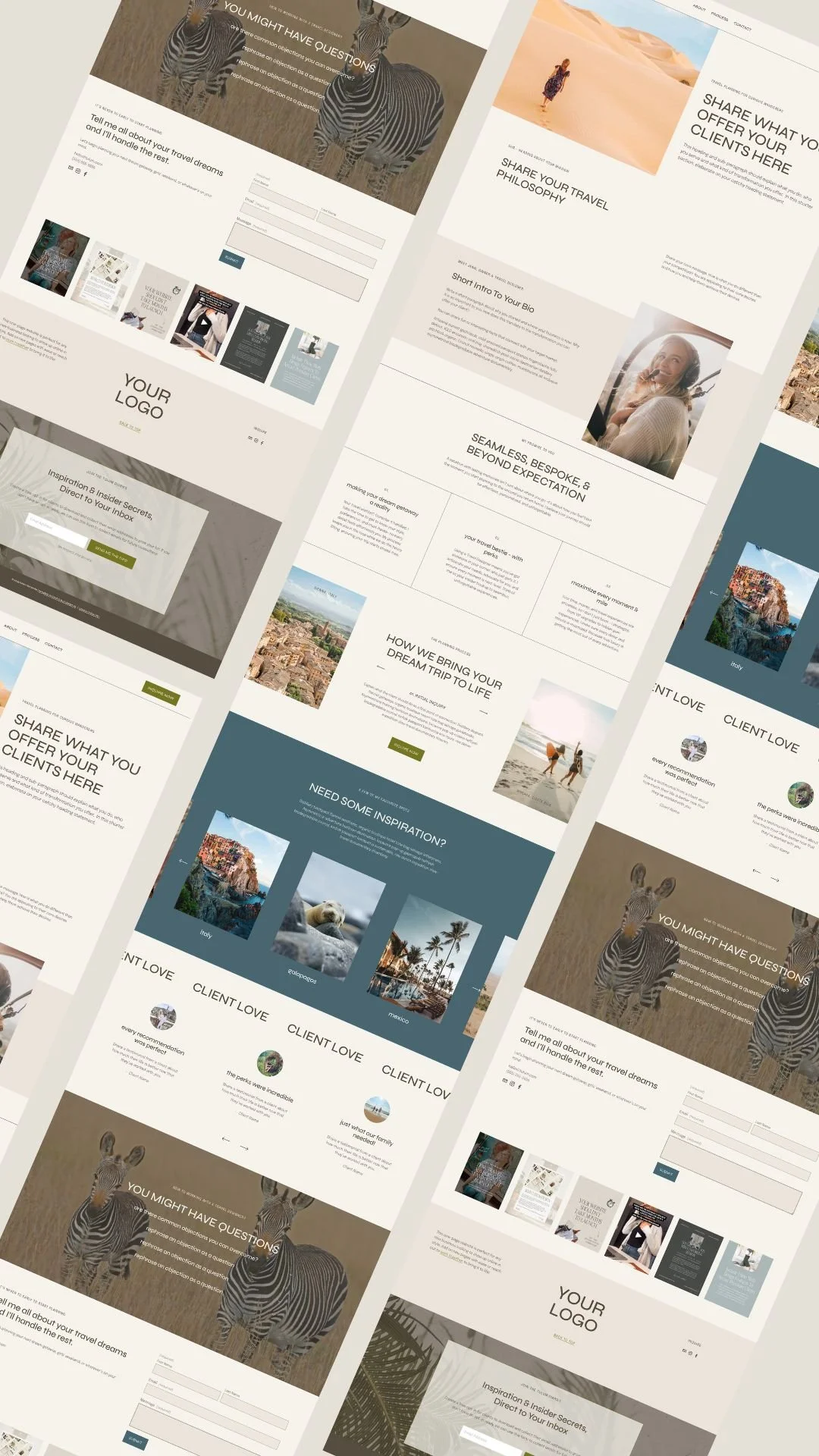






What's actually behind that 'this looks expensive' feeling, and what's working against your positioning without you realizing it. Written for independent Travel Advisors in the FIT, luxury and premium market who are past the 'do I need a website' question