
How to Stop Sounding Like Every Other Travel Advisor Online
Blog Overview: Your website copy sounds professional. It's warm, it mentions your experience, and it could belong to almost any travel advisor online. If that sentence landed somewhere uncomfortable, this post is for you. We're covering why generic copy happens, what brand voice actually looks like in practice, how to figure out which voice type you are, and what to do with that information once you have it. [About an 8-minute read]
You've rewritten your About page three times this month. The current version is fine. It's warm, professional, mentions your years of experience and your love of travel, and it sounds almost exactly like the five other advisors you follow on Instagram. You know this. You stare at it for another minute, change one word, change it back, and close the tab.
(We've all been there.)
The problem isn't that you can't write. It's that you're trying to write before you've done the thing that has to happen first.
The Step Most Advisors Skip Before Writing Anything
Before you write a word of website copy, a bio, a caption, or an email sequence, there's a layer of thinking most people skip. Not because it's hard, but because nobody told them it existed.
That layer is your brand voice. Not a list of adjectives on a sticky note. A real, documented understanding of how you sound when you're at your best. The words you reach for, the ones you'd never use, what your emails sound like when a client writes back and says 'that's exactly what I needed to hear.'
The advisors whose copy stands out aren't the ones with the most credentials or the most polished design. They're the ones who sound like themselves. And that's not specific to travel advisors. We're all craving personality, someone we actually click with.
That matters more now than it ever has. Every industry is saturated, and AI tools can produce passable copy in seconds, which means passable copy is everywhere. The advisors who cut through aren't the ones with better prompts. They're the ones who know their voice well enough to brief those tools properly, or to recognize when a draft doesn't sound like them and fix it.
Generic in, generic out. That's not a Claude (or AI) problem. It's a voice problem.
What 'Brand Voice' Actually Looks Like: A Before and After
Take something almost every travel advisor writes at some point: a line about why they specialize in what they do.
Without a clear voice: 'I specialize in luxury African safari experiences. I work with premium suppliers to create unforgettable journeys for discerning travellers.' 😴
With a specific voice: 'The thing nobody tells you about safari is that it's not really about the animals. It's about sitting in complete silence in the middle of somewhere vast and wild and feeling genuinely small in the best possible way. I plan these trips because that feeling is worth every cent, and I want people to experience it.' 🙌🏻
Same offer. Completely different person. The second one you remember. The first one you scroll past.
Voice isn't about being a better writer. It's about being a more specific one.
What Generic Copy Actually Costs You
Clients are comparing you before they ever reach out.
Picture this: someone has two advisor websites open in separate tabs. They read three sentences on each. One sounds like a real person with a clear point of view. The other sounds polished but could belong to anyone. They close one tab and send an inquiry through the other. You never know it happened, and you never find out why.
The internal cost is just as real. When you don't have a documented voice to work from, you start from scratch every single time. Every caption is a guessing game. Every bio rewrite takes longer than it should. And when you sit down to use AI tools to help (which most of us are doing now), you're handing a blank slate to something that defaults to the average of everything it's ever read. That average is exactly what you're trying not to sound like.
Having your voice documented changes all of that. Writing gets faster because you're not reinventing yourself every time you open a doc. Copywriters deliver better work because they actually know what you sound like. And AI tools stop producing generic drafts because you've given them something real to work from.
The 6 Travel Advisor Voice Types: Which One Are You?
Now for the part that actually helps you name what you sound like. Most travel advisors land in one of six voice archetypes, or a blend of two. And if you've never named which one you are, that's a big part of why your copy keeps coming out sounding like everyone else's.
Think of these less as categories and more as the pattern underneath how you naturally think about the work. Finding yours isn't about picking one. It's about recognizing the one you've already been.
The Curator: Speaks from personal vetting and selective taste. 'I've stayed here myself, and most places in this region aren't worth what they charge.'
The Adventurer: Speaks from genuine enthusiasm for pushing past the obvious. 'Let's skip the resort everyone else is booking and do something you'll actually remember.'
The Insider: Speaks from relationships and access. 'I'll call the GM when you check in, she knows to look out for you.'
The Realist: Speaks from honesty about what's actually worth it. 'That property gets great photos, but the service has slipped. Here's what I'd book instead.'
The Problem Solver: Speaks from calm competence with complexity. 'Multi-gen trip with three dietary restrictions and a tight connection? Yeah, we can work with that.'
The Guide: Speaks from depth of knowledge and context. 'Most people don't realize how much timing matters for this region. Let me show you why.'
Think about how you talk on discovery calls. Not how you think you should sound, but how you actually sound when the conversation is going well, and you're in your element. That's your primary archetype. Most advisors are a blend of two, and if you've never named yours, that's part of why your copy keeps coming out feeling slightly off.
When you don't know which direction you're naturally pulling in, you default to the middle. And the middle is where every advisor's copy sounds the same.
The Difference Between an Archetype profile & Tone of Voice
Archetype
how you think and what you bring to the relationship. It's the substance. The lens. The thing clients are actually hiring you for underneath the friendly vibe.
Tone
how that substance sounds when it comes out. Warm, casual, polished, dry, playful, serious — that's all tone.
For example, ‘BFF-friendly casual’ is a tone. It's how you deliver whatever your archetype is.
You can be a casual, friendly BFF who's also:
A Curator — 'okay so I stayed at this place last year and I need to tell you about it, the breakfast alone is worth the trip'
A Realist — 'listen, I love you, I am not letting you book that hotel, it is not what the photos suggest'
An Insider — 'oh I know the concierge there, let me text her real quick'
A Guide — 'okay so here's why Puglia in June is a completely different experience than Puglia in August, stay with me'
A Problem Solver — 'okay complicated multigenerational trip with three dietary restrictions and a grandma who can't do stairs, I'm in, let's figure it out'
An Adventurer — 'please tell me you're open to skipping the resort, I have an idea'
Why This Matters for Your Positioning
If you've been stuck on your positioning for as long as you've been stuck on your copy, those two things are usually connected. Archetype and niche aren't the same thing, but they pull on each other. A natural Realist will probably never feel at home marketing themselves as a 'curated luxury experience' specialist, even if they can absolutely plan the trip. A Guide who loves explaining the why behind every recommendation will struggle to sound right selling fast, transactional all-inclusives.
When your archetype and your niche are aligned, your marketing writes itself. When they're not, everything feels like it's fighting you. Voice first, niche second. The positioning that actually fits you tends to emerge from knowing how you naturally think and communicate, not from picking a lane and trying to sound like it.
How to Find Your Brand Voice
'Finding' your brand voice isn't a writing exercise. It's a thinking exercise. You're not producing copy, you're doing the work that makes copy possible.
It looks like answering honest questions about how you actually communicate:
How do you talk to clients on discovery calls?
What frustrates you about typical travel advisor copy?
How would your best clients describe the way you communicate?
What do you sound like when you're genuinely excited about a recommendation, not performing excitement?
Your first instinct on these is almost always right. The overthought answer is rarely the true one.
A Resource That Does the Thinking With You
I built a Voice Discovery Guide specifically for travel advisors that walks you through five exercises to identify how you actually communicate. Your natural tone, the words you reach for, the things you say that nobody else would say quite that way. It's the work you do before you write anything, before you hire a copywriter, before you brief a designer, before you ask an AI tool to write in your voice.
After answering guided questions and identifying which archetypes resonate, you calibrate against real examples and arrive at a completed Voice Profile. Three words that describe your voice, documented examples of what it does and doesn't do, and a sample sentence that sounds exactly like you. Something concrete you can reference every time you sit down to write, hand to a copywriter with confidence, or use to brief an AI tool so the output actually sounds like you instead of everyone else.
Give yourself 60 to 90 minutes. Do it in one sitting or spread it across a few days. Either works. Some people prefer to let a section sit overnight or come back to it again before moving on.
If you've been circling the same About page bio for longer than feels reasonable, this is probably what's been missing. Not better words, just a clearer sense of the specific words you're looking for. That's a solvable problem, and one of the most satisfying ones to work through once you actually sit down and do it.
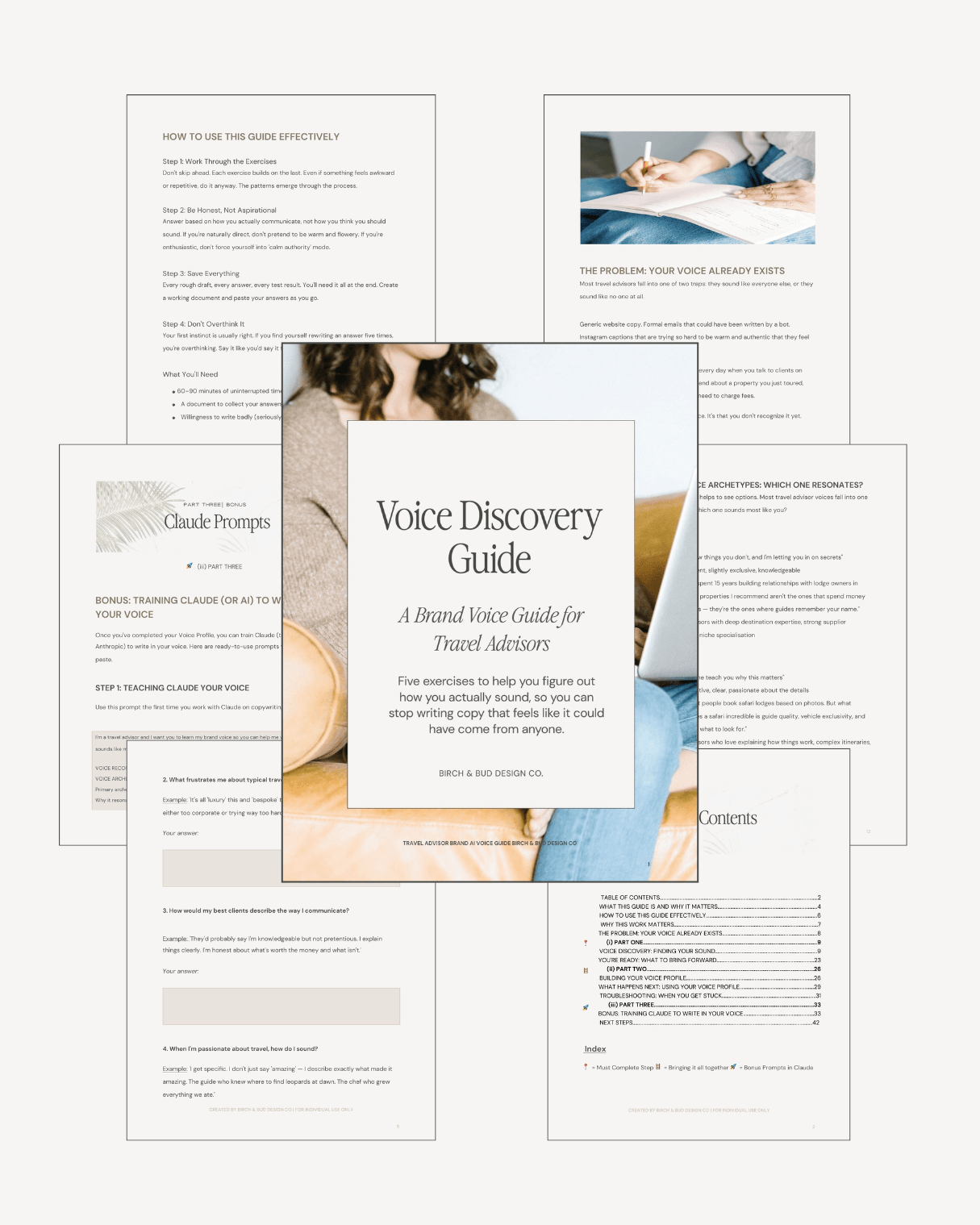
The Voice Discovery Guide for Travel Advisors
This guide takes you from 'I know what I want to say, but I can't get it on the page' to a completed Voice Profile you can actually use.
Five exercises, practical examples, and a finished document at the end.
PS. If you want to go further, Build Your Brand Voice with Claude covers the whole strategic foundation: your ideal client profile, your brand voice, and a complete system for using Claude across your marketing so everything you put out actually sounds like you, consistently.
🚀 LAUNCHING IN THE SHOP SOON 👀
Your Website Should Sound Like You Already Do
You know how you sound when a discovery call is going well. When a client says, 'that's exactly what I was looking for' and you can feel that the trust is already there. Your website copy should create that same feeling before you ever get on the phone.
If your website isn't doing that yet, I can help! At Birch & Bud Design Co., I build websites for travel advisors who want to attract the clients you actually dream of working with, and we get there by making sure your site sounds like you.

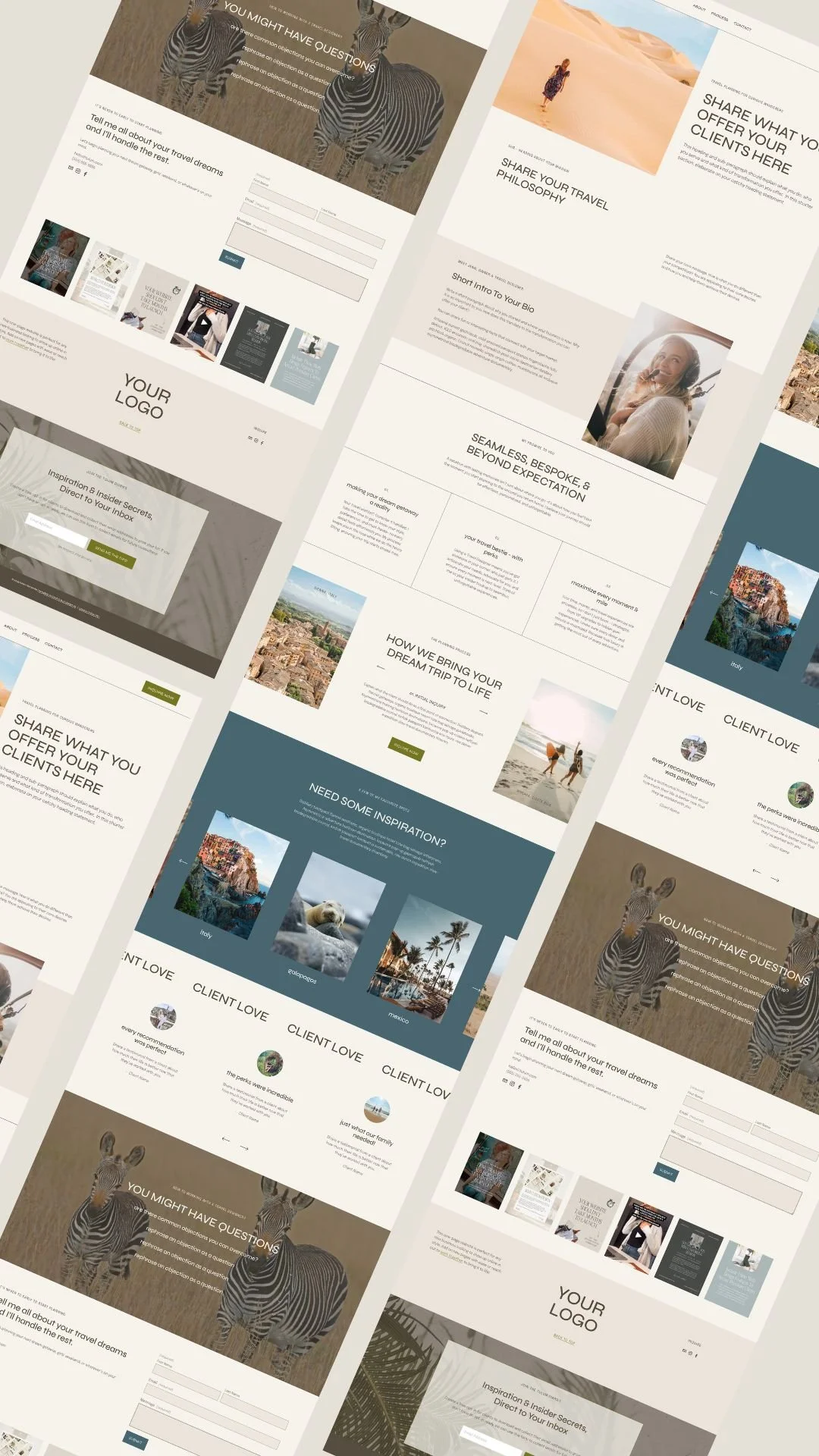






What's actually behind that 'this looks expensive' feeling, and what's working against your positioning without you realizing it. Written for independent Travel Advisors in the FIT, luxury and premium market who are past the 'do I need a website' question